Distant Writing

A History of the Telegraph Companies in Britain between 1838 and 1868
Home
Introduction
Cooke & Wheatstone
The Electric Telegraph Company
Competitors & Allies
Wheatstone
The Universal Telegraph
Bain
Non Competitors
How the Companies Worked
What the Companies Charged
The Companies and the News
The Companies and the Weather
The Companies and Foreign Traffic
The Companies' Foreign Operations
Railway Signal Telegraphy 1838-1868
Technical Detail
Finale
Instrument Gallery
Appendices
Sources
Download
Contact
Legal
TECHNICAL DETAIL

This Chapter provides a description of mid-nineteenth century telegraphic and associated equipment, company by company; pictures of their telegraphs can be found in the Instrument Gallery
 
A significant technical detail was that at this time the British domestic telegraphic circuits were not in continuous charge; unlike in the United States where the line was always ‘live’. The electrical source was only applied when messages were to be sent, that required was moderate by comparison.

Construction of domestic lines of telegraph in Britain was undertaken, with minor exceptions, by the companies themselves. They engineered the lines; employed and managed the necessary labour gangs directly, without the use of contractors. Iron wire, insulators, underground cable and iron conduits were purchased from manufacturers for both construction and for maintenance, by-and-large, to the companies’ patents and design specifications. It is clear from their annual reports that large quantities of telegraphic stores were maintained by the companies for maintenance, renewals and new lines.

There was a difference with regard to underwater cables: the Electric company laid its own, the Magnetic and Submarine relied on contractors.
 
Railways or Roads? – As has been noted the Electric Telegraph Company and the British Telegraph Company negotiated wayleaves or rights to make their circuits paralleling the new railways. The obvious alternative to telegraphs alongside of railways was alongside of public highways. The roads of England and Scotland were carefully made up and solid, and, despite the introduction of the railways, were still well maintained.

The Special Acts of the telegraph companies gave them general powers to open up and pass wires through or over any public road without compensation, provided notice was given to the local surveyor of roads and that the surface was reinstated. This provision was used by all of the companies for underground street circuits in cities and towns. Only with the advent of the new companies after 1851 were roadside lines adopted for long lines; virtually all of these roadside circuits were made underground as resin-insulated cables protected and concealed in wooden troughs or iron pipes. 
 
Only the British Telegraph Company used its general powers to attempt short roadside overhead wires in the 1850s where it could not gain a railway wayleave. Pole circuits along roads led to public objections, from their intrusive nature and from the damage caused to the trees that lined most of the coach roads. The overhead wire circuits on open roads were also particularly vulnerable to vandalism.
 
At the end of the decade the Magnetic Telegraph Company was compelled to adopt roadside overhead wires when its many long underground gutta-percha cables began to decay in 1858; extending them even into city centres, high over the tops of houses.

In the 1860s the United Kingdom Electric Telegraph Company was the first to generally adopt overhead or pole circuits alongside of the city to city coach roads. It met with immense public opposition, particularly from landlords with country estates and other property bordering the highway being “poled”. This hostility was encouraged by the competitive companies.

Apparatus - In 1845 the Electric set up workshops to manufacture instruments, and all of the companies bought instruments and components from patentees and manufacturers. Manufacturing and maintenance continued at the Electric and Magnetic companies’ own workshops.

In general between 1840 and 1870 public telegraphs in Britain used needle instruments for sending and receiving messages, connected from the earliest days by pole-suspended, overhead wires retained on insulators made of earthenware pottery, worked with galvanic batteries.

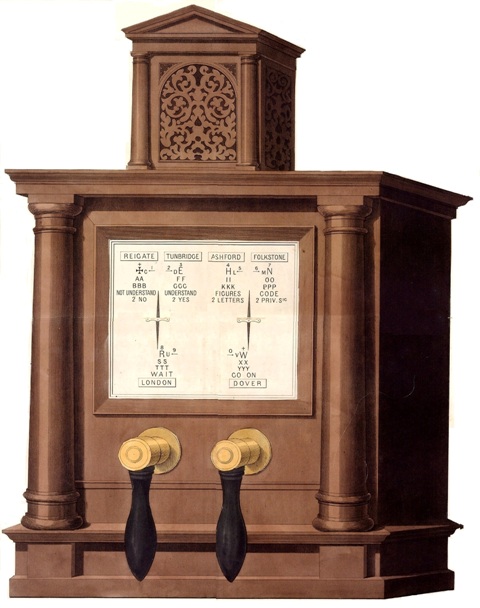
The needle instruments, almost unique to Britain, indicated the telegraphic message on a large dial by means of one or two index hands (‘needles’) moving either left or right to indicate the elements of a code or cipher. Each needle was worked electrically from behind the dial face by a small galvanometer.

The sending mechanism could be one or two small cylindrical commutators or switches worked by handles; or by keys (the latter known then in Britain as ‘tappers’ or ‘pedals’), both connected to batteries; or by small magneto-electric devices (what might be termed pulse-generators) without batteries.

The First Telegraph – The initial apparatus used by Cooke & Wheatstone was the five-needle telegraph requiring a six-wire circuit patented in 1837. It had five pairs of keys to work the five needles, left or right, on a diamond-shaped dial. This indicated twenty letters from the Roman alphabet and ten numbers. A single needle was used to indicate a number (1 to 5 left, 6 – 0 right), two needles together indicated a letter. After a few minutes practice anyone who could read and write could work this device; for publicity purposes deaf children were allowed to operate it, and did so with ease. However user-friendly it might have been the need for six wires, that is five plus a common return, in a circuit made the five-needle telegraph uneconomic.

The original copper wires used on the earliest circuits were insulated by a covering of cotton or silk laid spirally over the wire; the cotton was steeped in india-rubber to protect it from the damp and then immersed in pitch and laid in wooden battens or small-bore iron pipes. The battens were buried in the earth. The pipes were mainly carried on short posts, but were also laid in the dampest conditions underground, even underwater. As an example, ten wires were laid in a two-inch diameter iron gas-pipe alongside of the London & Blackwall Railway in 1841. Cooke was to introduce a weight-driven air-compressor to keep the iron pipe pressurised and so free of water. The pipe joints were never air- or water-tight and the caoutchouc resin eventually cracked in heat.

The American Telegraph - The system patented by S F B Morse in 1846 was commonly called the ‘American Telegraph’ by Government, by the telegraph companies and by the press in Britain during this period.

It originally consisted of a ‘key’ to make and break an electrical circuit, a ‘register’ that had an electro-magnetically-controlled point scratch a mark on a mechanically-driven roll of paper, and a ‘relay’ that took the weak line signal and amplified it in a separate local circuit to work the register. The ‘register’ was a substantial piece of equipment requiring a strong current and a clockwork source. It had to be kept wound-up and to be turned on when a message was signalled. In Europe, by 1856 the scratching mechanism was replaced by a sensitive inking device that printed dots and dashes on the tape, and which required far less pressure and electrical current, rendering the local relay unnecessary. Digney in France and Siemens & Halske in Prussia perfected the ‘inker’ or ‘writer’ from an idea by Thomas John, an official of the Austrian k.k. Staatstelegraph, in 1854. This, the ‘key-and-writer’ rather than the ‘key-and-register’, was the working mode of the American telegraph in European service.

The reading of the scratch marks on the tape of the original register was in any case difficult and in America operators learned to interpret the movements of the device by its sound. By 1859, much against the wishes of S F B Morse, the sounder or acoustic telegraph was introduced in American service. This was a simple, small electro-magnetic device that clicked in time with the distant key, replacing the old register of 1846.

It needs to be emphasised that all the telegraphic terminal instruments described required constant attendance. There was in this period no apparatus that received a message entirely automatically. The needle and dial telegraphs needed a clerk at either end to send and receive. The American registers and writers and the type-printing telegraphs all had to be manually switched into the circuit on receiving an alarm from a distant station and the clockwork mechanisms needed to be often spanned to assure uninterrupted traffic.

A significant early change in technical operation was the move away from instruments requiring a two-wire circuit with earth returns to the much more economical single-wire circuit with earth return. This applied particularly to the two-needle telegraphs of the Electric and Magnetic companies; most contemporary and all subsequent devices used a single-wire circuit.

Connections between electrical circuits within telegraph offices were made with a series of turnplates, small rotating brass switches of many designs. At larger offices the turnplates occupied much space and time in their switching functions.

Most telegraph offices in Britain were equipped with at least one desk-top galvanometer or a portable detector to measure the current in its lines and the state of the batteries. In appearance these were small single-needle instruments in fine wood cases, calibrated in degrees to record greater or lesser current.

The other common device in all offices was the lightning protector or paratonnerre which diffused the effects of extreme static electricity that otherwise might damage instruments and even clerks. There were all manner of contrivances for this purpose, affixed to walls or on working desks in circuit between the instruments and the line of wire, with their own lead to earth.

Underground Cables - Whilst needle instruments remained universal in Britain, for a period between 1852 and 1859 underground wires insulated in a resin, commonly gutta-percha, and protected by lidded-troughs or in iron pipes were laid instead of pole telegraphs. Underground wires were apparently impervious to weather, vandalism and similar dramatic interrupters of traffic. All the extant companies constructed subterranean circuits for their trunk lines during that short era, virtually abandoning overhead wires to railway signal telegraphy. Although more secure these circuits required a much greater current; six twelve-cell batteries could work 200 miles on a well-insulated iron-wire pole line but only 100 miles with a gutta-percha insulated copper-wire cable.

Then, in 1859, there were catastrophic electrical failures on a great many underground circuits as the gutta-percha insulation oxidised in air and disintegrated after several years’ exposure. In 1849 the extensive subterranean Prussian and Danish telegraph systems built by the Siemens firm on a much cruder technical base, using “sulphuretted gutta-percha”, laid under 24 inches of soil in a lead sleeve, had similarly collapsed after just a few months’ service. Sulphur had been added to strengthen and improve the insulative qualities of the resin; but in addition it caused the copper to dissolve and in some instances the small current created a chemical reaction that ignited the gutta-percha.

Fortunately, the sale of the copper cores of the underground resin-insulated wires met a substantial part of the costs of replacing them with overhead pole lines.

With regard to underground (and to underwater) circuits it was found during experiments between 1859 and 1861 that the composition of the materials used was critical; there were large differences in the purity of copper metal, and gutta-percha was found to be delicate in its composition with air-bubbles, contaminating fibres and unexpected internal weaknesses, as well as sensitive to temperature. A major cause of electrical failure was in the jointing of the copper wires where lapping and soldering together made the core brittle.

There was argument over the merits of india-rubber over gutta-percha as an insulator. India-rubber was found to be the better electrical insulator, easier to join and more consistent in manufacture than gutta-percha, although its properties were such that it could not be drawn through dies for continuous covering.

For a short period in the early 1860s india-rubber was the more popular medium used to insulate under-ground cables, internal circuits and for insulators on overhead wires on poles. Caoutchouc or india-rubber had been advocated and used as an insulator for wire since 1838 by Charles West. He had unsuccessfully promoted a cable to France in competition with the Brett family, and had laid the earliest successful submarine telegraphic cable one mile across Portsmouth harbour for the Admiralty in 1845; it was still in use in 1860. West was engineer to several unsuccessful cable companies, including the Irish Sub-Marine company, and later became associated with S W Silver & Company, long-established manufacturers of caoutchouc goods. He developed with them a machine for spirally-winding thin india-rubber around copper wires to create cable cores. Silver & Co patented and manufactured underground and underwater caoutchouc-insulated cables and hard-rubber insulators for poles. However india-rubber was found on investigation and experience to be far less durable, being especially vulnerable to oxidisation in sunlight and general decomposition though weathering and age.

All of the issues raised were addressed with new processes. The sourcing of fine copper and its refining was immediately improved. So-called “pure gutta-percha” was introduced in 1861 that eliminated the contaminants and faults, and it regained its precedence in underground and underwater cable insulation until synthetics were introduced almost a century later.

There was, however, a general re-adoption of pole telegraphs in the 1860s for long distance lines and a flurry of patent applications for new insulators for overhead wires. Unlike in America the insulators used in Britain on these poles were not glass but glazed earthenware. In the period between 1838 and 1868 there were patents covering improvements in these so-called porcelain insulators, as well as a number later in the period using natural resin (ebonite, a form of vulcanised india-rubber) and resin-impregnated wood.

The principal technical differences between the companies in Britain were:

a.] The Electric Telegraph Company worked the master patent of Messrs. Cooke and Wheatstone between 1845 and 1852 at first utilising two-needle telegraphs operated initially by ‘S’-shaped handles, then, and more commonly, by drop handles. It used two-wire circuits, with earth return. The two-needle apparatus was considerably faster in working than the later single-needle device but this was counter-balanced by the cost of instruments and wires. In case of breakages in one or other of the wires the clerks were taught an abbreviated code using one of the two needles on the dial. Its use continued into the late 1870s.

The single-needle telegraph worked by a drop handle, with a single-wire circuit, introduced in 1848, was the Company’s commonest apparatus in its public circuits from the mid-1850s until 1868.

Described in the 1840s, “each needle was suspended in a light hollow frame of wood or metal, round which were wound two sets of fine copper wire, coated or insulated with silk or cotton. About 200 yards of fine-gauge wire is used. To prevent oscillation the lower point of the needle was slightly weighted. Below the needle was a handle, so formed as to turn on or break off the connection with the battery with the conducting wires, so to transmit motion to the needle, deflecting it either right or left.”

The advantages Cook & Wheatstone's two-needle instrument possessed over Bain’s and the American telegraph were stated in 1854; that it did not demand the same skilled hands to wind and adjust the machine and prepare the paper; it was always ready at hand, and only needed attention at long intervals; its disadvantages were, that it did not trace the message, and consequently left no telegraphic record for reference, and it required two wires, while the Bain writer and the American telegraph employed one; the current required to work it was the same as the former, and rather less than the latter.
 
As well as on the Electric, Cooke & Wheatstone’s two-needle telegraph was used between 1852 and 1854 on the circuits of the Submarine Telegraph Company between London, Dover, Calais, Brussels and Paris.


Cooke & Wheatstone's Two-Needle Telegraph
C V Walker's version with a switch between the drop-handles

The master and subsequent patents it acquired of Cooke and Wheatstone effectively locked-out all competition until 1852. The Company regarded others, especially Morse, as intruders.

As well as two-needle and single-needle instruments W F Cooke had patented the fault-finding detector, the principles of pole suspension, the principles of conduit wire-laying, lead-sheathing for subterranean wires and a variety of earthenware insulators for pole telegraphs.
 
The Company also offered Wheatstone’s magnet-and-bell device to railways and others, such as factories and mines. This consisted of a large finger-pedal or key that worked a horseshoe-shaped magneto; pressing the key produced a single pulse of electricity. The distant receiving instrument was an electro-magnet that attracted the spring-loaded striker of a brass bell. Each stroke of the key had the bell sound once. It was the first commonly used magneto-telegraph, that is one without galvanic batteries, and the first acoustic telegraph. The magnet-and-bell was manufactured until the 1870s for signalling in mines.

The principal technical problem faced by the Company in its early years was an understanding of insulation of the circuits. The original circuits of wires in pipes were of such a nature that transmitting messages up to just twenty miles was difficult. The introduction by W F Cooke of overhead wires on poles insulated from the earth by glazed earthenware discs in 1842 allowed distances of more than one hundred miles to be worked successfully. It was the perfection over time of the insulation along the line and within stations that made the geographical progress of telegraphy possible.
 
In 1849 the Mechanics’ Magazine reported that rain and fog rendered the insulation of the overhead lines defective, and that in October of that year frost was breaking the iron wires on the long-line alongside of the London & North-Western Railway. The problem was such that in the dampest weather “contact” was created between adjacent wires at the poles and the clerks were compelled to hunt for a single “dry” two-wire circuit from among the eight or so wires on the hundred miles between London and Birmingham, delaying and disrupting all but through traffic. In fact it was impossible for periods to have a direct circuit beyond Birmingham; messages had to be collected there and re-sent on a new circuit to stations north.

The ceramic insulators were originally attached directly to the sides of the pole; cross-bars on the pole were not introduced to the Electric’s circuits until the mid-1850s. As noted Cooke’s original insulator was a flat ceramic disc. The Company’s first insulator was Cooke’s earthenware barrel, No 1, the next was Edwin Clark’s metallic-bell-topped earthenware model of 1850, No 2, perfected in 1851 as a wholly-earthenware bell, No 3; the last insulator adopted was Varley’s double-bell earthenware model of 1861, No 4; each introducing improvements intended to reduce current escape through atmospheric moisture.

W F Cooke’s earliest overhead or pole lines of 1842 on the Great Western Railway were formed of 9 foot cast-iron posts, much like the standards of street gaslights, with a 4 foot tall ash-wood headpiece to which short, separately-insulated vertical battens were attached on either side. The improved hollow, barrel-shaped insulators for the circuit wires were stapled horizontally to the battens; the wire was threaded though the core.

The overhead iron wires suspended in the circuits of 1845 to 1848 were of No 8 Birmingham Wire Gauge, which is about 1/6 of an inch in diameter, and weighing about 480 pounds to the mile. It was welded into lengths of one-quarter mile at manufacture. The standards or poles were then set 45 to 50 yards apart. The only exception to this was the wire on the very first long line, that between Nine Elms and Southampton, which was to No 7 gauge.

These early lines had intermediate winding posts with a small drum and ratchet mechanism instead of a simple insulator for each wire by which tension could be adjusted every quarter-mile. The wire merely passed though the centre of all the other pole insulators, disc or barrel, on the line without being secured.

The winder was soon regarded as an unnecessary complication and the wires were then tensioned between every pole and secured firmly to each barrel insulator.
 
During the late 1840s the poles were of squared Memel fir, treated to preserve the timber, fifteen to twenty feet long, six to twelve inches square at the base and four to six inches square at the top, painted white above the ground, charred and tarred below ground to prevent rotting. The poles were set between 50 and 70 yards apart. The Company’s No 1 earthenware barrel insulators were attached by u-shaped iron staples directly, four wires to either side, to the post. A small wooden “roof” was set on the head of each pole to divert rain.

Round larch wood replaced squared Baltic fir for all telegraph poles from 1850. The poles cost from 3s 6d to 4s 0d each in 1853.

Several patent processes existed for preserving timber. The first used for poles was Kyanizing, impregnating the wood with mercuric chloride, dated from 1832 and was used in the earliest lines of overhead telegraph in 1843; however the preservative rapidly corroded ironwork. Burnettizing, impregnating the wood with zinc chloride, was tried between 1844 and 1845. Eventually the simpler, cheaper Bethelizing process, dating from 1838, was adopted from 1848, which forced creosote into the wood of the pole under vacuum and did not necessarily require over-painting.

The Timber Preserving Company was formed by Act of Parliament in December 1849 to absorb the firms that worked Bethell’s, Margery’s and Payne’s processes for preventing rot in wood. It had offices at Whitehall Wharf, Cannon Row, Westminster, and undertook its operations at Durand’s Wharf, Trinity Street, Rotherhithe on the River Thames. They offered to prepare railway sleepers and poles for telegraphs for 5d each.
 
The Company adopted Alexander Mitchell’s patent screw-piles and screw-pile shoes, to secure its posts and their bracing wires. This, for telegraph poles, was an iron cylinder with a two-stage auger on its base for quick and very secure insertion into the ground. A miniature elongated version was used to embed the iron bracing wires.

Poole’s portable wire-stretcher was used for drawing the ends of iron wire together using two clamps connected by a system of levers so that they might be permanently joined. Poole was a patent agent, so the real originator is not known.

Only from 1852 did cross-bars secured by an iron staple appear on the Electric’s poles as the need for more and more parallel circuits appeared. The Clark No 2 and No 3 insulators then being suspended from beneath the cross-bar; in 1861 the latest Varley No 4 insulators were screwed into the top of the cross-bar.

The wire for overhead lines continued to be solid-drawn No 8 BWG (Birmingham Wire Gauge) diameter galvanized iron, but now weighing 387 pounds a mile.
 
On the South Eastern Railway, which used Cooke & Wheatstone’s system, a great snow storm over April 19, 1849 brought down its No 8 gauge wires and sixty line-side poles through the weight of ice.

In April 1859 C F Varley said that he was using much heavier No 3 BWG iron wires on the important long overhead lines at the side of the London & North-Western, Great Western and London & South-Western railways. He would “never again” use No 8 gauge iron wire on lines more than 200 miles in length as the thicker wire had far less electrical resistance.

However, overhead iron wires on poles were not suitable for tunnels, under bridges and through the streets of urban areas. W F Cooke had patented the first underground cable in 1840. This consisted of up to nine varnished No 16 gauge copper cores each protected by tar-coated cloth, drawn in clusters of three or four through solid–drawn lead pipe, covered overall with a tarred rope outer. It was first laid under the footpaths to connect the Company’s existing London offices in 1845 and then through tunnels along the London & Birmingham Railway in 1847. These very limited circuits, expensive and complicated to lay with their lead outer-sheath, lasted for twenty years.

The Company eventually had a small network of underground circuits in most cities. They were laid to a common model in 3 inch diameter socket-ended cast-iron pipe sections, each 9 feet long, weighing 100 lbs, located under the footpaths of streets, divided into sections by proving- or test-boxes on 3ft high iron posts every 440 yards. The upright posts were later replaced by flush test-boxes set into the pathways; iron cases 28 inches long by 10 inches wide by 12 inches deep with flagstone covers, inset every 50 or 100 yards.

As the iron pipes of the conduits were being laid a single iron ‘leading-in’ wire was threaded through. The subterranean cable of a copper core insulated with gutta-percha resin and protected by a serving of cotton or rope was prepared in 400 yard lengths on wooden bobbins. An iron frame fitted with two wooden rollers was positioned over a flush box on the piping; the cable was run between the rollers to avoid chaffing to be attached to the ‘leading-in’ wire in the pipe. The wire was then pulled through along with the cable by man- or horse-power. The Company’s jointers numbered each circuit cable with metal tallies and then permanently connected the circuits as laying the line proceeded.

The subterranean wires were manufactured by the Gutta-Percha Company of Wharf Road, London. This used the Gutta-Percha Covering Machine, patented by Charles Hancock in July 1848 and assigned to the company; the machine hot-rolled up to seven copper wires with the resin through a die. Its invention came after W H Hatcher, the Electric company’s secretary, had approached Hancock in 1847 suggesting that the newly-discovered resin might be used for electrical insulation.

Originally, on its introduction in July 1849, there were three No 16 BWG copper wires in each underground core insulated with resin up to one-half-inch diameter. This was soon abandoned as one failure disrupted three circuits, to be replaced with a single No 16 BWG copper wire covered in gutta-percha to No 3 or 4 BWG thickness. In 1850 double-coating of resin was introduced as a further insulative measure and became general. The insulated cores were protected by tarred cotton tape and sanded, and weighed 85 pounds per mile.

In keeping with the short-lived technical fashion of the 1850s the Electric company introduced long-distance subterranean lines insulated with gutta-percha. Edwin Clark adapted its existing underground city system in 1853 to lay eight separately-insulated copper cores bound together as a cable with sanded, tarred tape and jointed in quarter-mile lengths, within cast-iron or earthenware pipes for its so-called ‘Express Lines’ alongside of the London & North-Western railway between London and Manchester and Liverpool in the north of Britain, its busiest circuits.
 
By 1860 the Company, after the failure of gutta-percha underground, had reverted to overhead circuits on poles for all of its long lines; with a new system devised by C F Varley, using heavy gauge iron wire and new, more efficient insulators.


Cooke & Wheatstone's Two-Needle Code 1843
 
Regarding other instruments, the Electric Telegraph Company acquired the rights to Alexander Bain’s chemical telegraph or writer which indicated a broken line on electrically-sensitive paper strip, which it used between 1848 and 1862 on its busiest circuits. In his patent he used a “finger pedal” or key to transmit electrical pulses to a wire touching the surface of a strip of chemically-dampened paper. The paper strip was slowly drawn by clockwork from a roll between the wire and a small brass cylinder that formed the return circuit. Pressure on the “finger pedal” caused the wire to make a mark on the paper, either a short dot or a long dash. It was particularly sensitive in operation, requiring less current than other telegraphs, so much so that it was planned to experiment with it on the Atlantic cable of 1857. To counter-balance this sensitivity, the circuits of the Bain writer were particularly vulnerable to interruption by “atmospheric electricity”.

Alexander Bain had devised by 1848 his fast telegraph - a variant of the chemical telegraph in which the “finger pedal” was replaced by a miniature hole-punch worked by a small mallet and fed with strips of paper. Messages could be prepared by several ‘punchers’ and the paper strips fed into a rotary sender between a wire and a hand-turned metal roller so that the punched holes made and broke the circuit. This enabled the rapid transmission of messages irrespective of the ‘hand’ of an operator. However the rotary sender and the receiving writer had to be carefully governed to work synchronously. The patent for the fast telegraph was immediately acquired by the Electric company.
 
Latimer Clark, the Company’s engineer, modified Bain’s fast telegraph by introducing a much improved, speedier punch for the paper tape in 1850. Using his punch the Bain printer regularly achieved 300 words a minute from tape.

It featured Bain’s electric clock in all of its offices, having several in the Central Station at Founders’ Court. This was a long-case time-piece in an oak body 4ft 6ins tall by 1ft 4ins wide. The normal clock face at the head read hours, minutes and seconds. The simple clockwork mechanism required no springs or weights but was regulated by a long pendulum at the base of which was an electrical coil in place of the usual bob. This was governed to move alternately between permanent magnets at either side of the body. A single pendulum might control several clock mechanisms. Bain advocated earth cells, zinc and copper plates or zinc and carbon in the form of coke buried in damp earth, to provide current; the Company used ordinary sulphate galvanic batteries for its electric clocks.

It acquired too, Edward Davy’s relay or repeater for extending its domestic circuits, an improvement on that patented by Cooke & Wheatstone, although pre-dating it, and Henry Highton’s ‘gold-leaf’ telegraph in 1846.

The Company eventually bought Nott & Gamble’s and Brett & Little’s improvements in telegraphs in 1849-50 after fighting to convince the Courts that they were infringements of their patents.

In replacement of the Bain chemical writer on its long-distant domestic circuits in 1862 the Electric introduced the American writer or inker using Bain code, manufac-ured by Siemens, with an ink siphon to indicate signals on a clockwork-driven paper tape, worked with a sending key. Although less sensitive, requiring more galvanic cells in its operation, than the Bain printer the American telegraph also used a single-wire circuit so was a straightforward substitution of equipment.

The Electric latterly used two codes in its domestic circuits, single needle and Bain. The Company’s continued hostility to S F B Morse and his claims was such that it insistently retained Bain code and only used Continental Morse code, with its diacritical marks, in its foreign circuits to Europe - where it used the American telegraph.

The first use of the American telegraph in public service in England was in 1854 when it replaced the two-needle instrument on the International Telegraph Company’s circuit between London and Amsterdam so as to conform to Continental practice.
 
Frederick Bakewell’s copying telegraph, developed between 1848 and 1851 and tested by the Company, had manuscript writing or a drawing in varnish on tinfoil applied to a rotating cylinder six inches in diameter and about twelve inches long propelled by carefully-governed clockwork rotating at 30 revolutions a minute. A moving electric feeler on a long parallel screw “scanned” the foil differentiating between the metallic and varnished portions. The receiver was identical but the drum had a dampened sheet of sensitised paper on it and the metallic feeler passed the current through it, marking it in facsimile of the varnish writing.

A facsimile of a foil manuscript with 400 characters was distantly copied in two minutes over fifty miles.

The Electric experimented in 1854 with the system devised by the Rev Robert Walker, professor of physics at Oxford University, to transmit signals in both directions simultaneously on one wire.

In 1854 Cromwell Varley patented his double current system, which comprised a double-current key and polarised relays. This overcame the significant time-delay in signals using the single-current or American system in underwater and underground telegraphy. It could send twenty-five words with 300 current reversals in a minute, receiving on the American telegraph. The system was first introduced into the Company’s long-lines from London to Manchester and Edinburgh in 1854 and to the Holland cables in 1855. Another advantage was in the reduced need for current; only four Daniel cells were required for the Manchester line.

Varley’s ‘translator’ of 1855, an automatic system of batteries and relays or repeaters was introduced for point-to-point working with the American telegraph, the key-and-inker, between London and Amsterdam, and then between London and Berlin and eventually to St Petersburg in Russia. This permitted through working without transcription. The longest direct line from London to Odessa, by way of Amsterdam, Hanover, Berlin, Königsberg, Riga, St Petersburg and Moscow, was worked from 1858 with thirteen Varley translators at five to six words a minute. This line was often used by the Company to publicise its reach.

The original American relay used in long Continental circuits required continual adjustment due to the “natural” variations in current as batteries changed and conditions affected the state of insulation. Varley’s relays on the American telegraph were adjusted just once each day as they were brought into circuit.

The Electric company acquired the licence for Wheatstone’s automatic telegraph of 1858, introducing it on its long-line between London and Newcastle in July 1867, where it was in constant action transmitting from sixty to a hundred words a minute. Henceforth the Company used it on its busiest long-distance circuits. No other company could handle bulk traffic so effectively. This instrument maximised the usage of single circuits by allowing a constant feed of messages on punched-tape into the sender; at the other end the receiver recorded the code on another paper tape, in almost a continuous process. It had three components: the perforator, of which there were several, to enable fast message entry on paper tape; an automatic transmitter through which the punched tape was run at speed to transmit the code; and an automatic receiver, that inked the code onto plain paper tape.

Long strips of paper were fed through a perforating instrument with three keys (dot, dash and space) constructed so that the holes were made grouped to represent letters of the alphabet and other signs. The paper strip was placed in the transmitting instrument which on being set in motion moved it along and caused it to act on two pins in such a manner that when one of them was elevated the current was transmitted in one direction and when the other was elevated it was transmitted in the opposite direction. The elevations and depressions of the pins were governed by the holes and intervening paper. The receiving instrument or printing apparatus had two pens or inkers worked by electro-magnets so arranged that when the current flowed in one direction one pen was depressed onto a moving strip of paper and when in the opposite direction the other pen was depressed. The pins of the transmitter and the pens of the receiver could lift back with springs, permanent magnets or electro-magnets. The transmitter and receiver were driven synchronously by carefully-governed clock work. The patent also allowed the transmitter and its perforated tape to work a single-needle or double-needle telegraph.

The fourth instrument was an independent so-called ‘translator’ that allowed an operator to quickly imprint up to 30 different letters, numerals or symbols on to a moving paper tape by using permutations of just eight keys and a space button. This was not a telegraphic device but a simple typewriter; it was not worked in public service.

In 1860 Wheatstone amended the automatic telegraph to send and receive messages without using current reversal so as to work with the Electric’s newly-introduced Siemens inker-writers rather than his own more complex receivers. About ten per cent of the Company’s instruments were inkers by 1868.

The original Wheatstone automatic telegraph of 1858 gave an increase in message transmission performance of a factor of five over the single needle and key-and-writer apparatus.

The overwhelming bulk of its apparatus continued to be Cooke & Wheatstone’s single-needle telegraph worked by a drop-handle, slightly modified latterly to place a small angled wooden shelf just below the dial for the clerk to place and read message forms for transmission. It is hinted in several sources that clerks using the single-needle device received messages acoustically as they were able to differentiate the tones of ‘right’ and ‘left’ signals as the needle struck its stop pins.
 
C W Siemens observed that the instrument clerks worked their telegraphs with the left hand and wrote down messages with the right hand.
 
During the late 1850s the Company introduced the desk-top Umschalter, the first switch-board, in replacement for the mass of turnplates for switching. This device, also called at the time the Swiss commutator or current director, was used in major towns to connect local with trunk lines and with other local lines. It consisted of an elaborate peg-board of crossed copper strips, insulated from each other and connected as required by a copper spring-peg through holes at their overlaps. It could rapidly change and connect message circuits and manage internal battery circuits. Although often termed the Swiss commutator the “umschalter” was devised by Ing F W Nottebohm, technical director of the Königliche Preussische Telegraph in Berlin.

Samuel Alfred Varley’s chronopher apparatus was controlled by a clockwork-driven conical pendulum and was used from 1852 by the Electric Telegraph Company and the railway companies to send time signals from Greenwich Observatory to some 1,000 towns and railway stations. The time current was received at 1 pm each day, when ordinary message traffic paused, on the single-needle telegraph. The great clock at the Houses of Parliament and its bell, Big Ben, was also controlled by the chronopher.

S A Varley, brother of Cromwell, had previously improved the insulation of the Company’s overhead lines by introducing soldering of wire joints in 1852, in place of mechanical or wound joints in the iron wire. He was employed by the Company from 1852 to 1861.

The Electric company continually reviewed its technology: it experimented with G Caselli’s “pantographic telegraph” or pantélégraphe, a copying device, and P A J Dujardin’s type-printing telegraph, a competitor to the successful Hughes apparatus, in the mid-1860s but found them both unsatisfactory for public use. In its final years it also tried the simple American key-and-sounder working Bain code acoustically.

The Company’s pioneer underwater cable across the estuary of the Tay river in Scotland consisted of three relatively light single-cored cables bound together as one; its companion across the Firth of Forth similarly consisted of four single-cored cables laid as one. The Isle of Wight circuit was a four-cored cable; that to the Isle of Man was a single-cored cable. The Firth of Forth cable from Granton to Burntisland was marked by five green buoys to prevent damage by ships’ anchors. 

The Company’s four initial marine cables from Orfordness to Scheveningen on the Continent, actually owned by the International Telegraph Company, of 1853 were laid with single circuits in relatively light armour, the single core being covered with double coats of gutta-percha and cotton tape and yarn, armoured with No 8 BWG galvanised iron wire, weighing two tons a mile. The four cables were joined together as one at the marine league, three miles off the English and Dutch coasts for protection against ship anchors. The Gutta-Percha Company and R S Newall, makers of the very first underwater circuits, manufactured the cables. The Company laid them using its own vessel, equipment and crew, as it did with its all of its domestic and later foreign underwater cables.

Initially the first Holland cables worked well but were to suffer repeated damage by ships’ anchors, additionally the iron wire corroded more quickly than anticipated and required constant repair.

The Company’s original cables were replaced in 1858 by a single cable, comprising four copper cores of No 13 gauge covered with gutta-percha up to No 0 gauge and armoured with No 00 gauge iron wire, between Orfordness and Zandvoort for Haarlem. This was a very heavy and strong cable weighing six tons to the mile manufactured by the Gutta-Percha Company and armoured by Glass, Elliot & Co. Four years later an identically armoured four-core cable was laid by the Company between Lowestoft and Zandvoort.

The Holyhead to Howth cables failed in 1859 and had to be replaced in 1861. The Company sponsored a new cable to Waterford in southern Ireland during 1862.

The Electric Telegraph Company worked pneumatic tubes, as patented by its engineer Latimer Clark, in London, Liverpool, Birmingham and Manchester. It their final form they had a 1½ inch bore air-tight lead core within a 2 inch iron pipe passing from the instrument gallery of the main telegraph station to a branch station, under the streets. Power came from a small, one-horsepower high-pressure-steam beam engine in the main office basement evacuating air from an eight foot long by four foot diameter iron vacuum chamber, a two inch pipe led from this to the instrument gallery.

The cylindrical message-carriers were of gutta-percha resin covered in felt, 5 inches long by 1½ inches diameter, small bundles of message forms were pushed into the hollow core at the branch office. The carrier was placed in the open mouth of the tube and an electric bell rung at the main station, the pipe connected by a simple valve to the vacuum chamber and atmospheric pressure propelled the carrier to a vertical tube-station in the gallery where a spring buffer immediately cut off the vacuum and the carrier dropped out through a trap-door onto a counter. The carriers were calculated to travel at 40 miles per hour.

There were five pneumatic tubes at Telegraph Street; four external “circuits” for messages to and from the stations at Founders’ Court, Cornhill, Stock Exchange and Mincing Lane; and one inter-departmental “circuit” used for messages and documents.  

Latterly, to send message-carriers in the opposite direction, where necessary, the basement engine compressed air into a second iron chamber, a pressure reservoir, with a comparable valve arrangement to blow the carrier back to the branch office. Before that happened the message-carriers were returned by hand in bags. The vacuum and pressure air valves were turned on and off manually on hearing the electric bell sounded by the distant station. Cromwell Varley intended eventually to work the valves of these later pneumatic tubes remotely by means of electric switches.

The air also powered the perforator or tape-punching apparatus of the Wheatstone automatic telegraph, speeding up the keying of messages immeasurably.

b.] The British Electric Telegraph Company adopted Edward Highton’s telegraphic system in its Act of 1851. The principal element of Highton’s arrangements was a single-needle instrument worked by a pair of so-called tappers, similar in appearance to piano keys, instead of rotary switches or commutators and drop handles; and with a light horseshoe magnet inside the galvanometer coils and a squat diamond-shaped pointer on a dial instead of magnetized needles in both the coils and on the dial. It was said to be the cheapest of all telegraph instruments. Through this instrument the single-wire ground-return circuit was introduced generally into British telegraphy. The apparatus in the service of the British Telegraph Company used Highton’s own single-needle code.

Unlike other systems Highton’s evolved over a period of several years. The horseshoe magnets were patented in 1848, when they were worked with two wires by rotating commutators. It was in his patent of 1850 that Edward Highton introduced current reversal and single wire working, and the tappers were patented in 1852.

The Company’s iron wires were suspended from poles using Highton’s patent gutta-percha insulator; in this a silk ribbon was wrapped about the wire for about six-teen inches and covered by hot gutta-percha in a horizontal cone shape. When this remarkably elaborate arrangement cooled to a solid it was screwed onto the pole or cross-bar and varnished. It also used Highton’s rather more effective patent “bead” insulator, a pierced glass sphere inserted directly into the body of or sta-pled on to the shaft of the pole or pinned to a support-ing arm. Highton patented the cross-bar or horizontal supporting arm for carrying insulators on pole tele-graphs in 1848 and X-arms in 1852.

Edward Highton was a director of the Company until its merger. His tappers were in use in public telegraphy for over seventy-five years.

c.] The English & Irish Magnetic Telegraph Company worked William Thomas Henley’s system; he was a founding director of the Company. This was based about a magneto-electric telegraph instrument that did not require batteries of electric cells, but used a key or short lever to generate sufficient electrical force to affect a needle galvanometer. Henley’s telegraph had a large square dial set in a mahogany case at a slight angle up from the horizontal, with two needles. At either side was a short thumb lever that when depressed generated a pulse of electricity. Each lever worked one needle in one direction, so the instrument required a two-wire circuit. These instruments used what ought to be termed “Henley’s Code”.

There were two sizes of magneto telegraph: the commonest could send messages on overhead wires up to 200 miles or to 100 miles on underground circuits and cost £15. A very much larger magneto was used on the underground and underwater line between Liverpool, Belfast and Dublin, over 530miles, and cost £38.

Its main circuits were insulated with resin and buried underground in Henley’s patent protective troughs. It had tried unprotected gutta-percha insulated wire on its first circuit between Manchester and Liverpool in 1851 but this failed almost immediately and was replaced by a resin-insulated line in troughs.

Charles Tilston Bright, who had worked for both the Electric and British Telegraph companies, replaced W T Henley as engineer to the Magnetic company in 1852 and made substantial modifications and additions to Henley’s system. He had a comprehensive patent in 1852 covering improvements to Henley’s magneto telegraph - replacing his short-acting levers with more robust rotating handles, a new very efficient overhead insulator and several varieties of troughs for protecting underground circuits. Bright was then age 20.

Its underground circuits of 1852-3 in England and Ireland were created to Henley’s plans. For its main city-to-city circuits ten insulated wires were laid in troughs of grooved boarding, covered either with wooden or iron lids. Each copper wire was of No 16 BWG insulated with gutta-percha to No 3 BWG thickness by the Gutta-Percha Company, served over with two thicknesses of jute and Stockholm tar, and laid in the troughs in two rows to a depth of two feet.

Under busy streets of towns from 1852 the Company used cast-iron split-pipes of Bright’s design each of six feet length with a two-inch bore, the metal 3/8 inch thick. The top and halves were secured together by two pairs of lugs and small nuts and bolts. Similar split-pipes, whether round or square in section, were to be adopted by all the other companies except the Electric.

The cost of laying six wires in troughs or pipes along the mail roads was from £180 to £200 a mile; for ten wires the cost went up to £230 a mile.

The overhead lines that it built, mainly in Ireland, were on round larch poles with insulation for the No 8 gauge iron wires originally formed, after Henley’s plan, from small cylinders of gutta-percha, called by the inventor “thimbles”. The resin tubes were speedily replaced in 1852 by large earthenware insulators designed by C T Bright. The Magnetic allowed only eight wires to be attached to each pole.

The Company’s clerks, according to Bright, received messages on the magneto-electric telegraph acoustically as the left and right needles struck pins with slightly differing tones.

The principal disadvantage of the magneto-electric telegraph was the need for a two-wire circuit.

d.] The European & American Electric Type-printing Telegraph Company was formed to work the telegraphic system of Jacob Brett. This is somewhat misleading as Royal Earl House in the United States had communicated the patent granted to Brett in Britain. The instruments used on its circuits were the Brett-House type-printing telegraph, a complicated device that produced alphabetic print on a paper strip; it required, however, only a single wire circuit with an earth return. Its wires were insulated in resin and buried underground in William Reid’s patent wooden troughs. Jacob’s brother, John Watkins Brett, was a director of this Company and was also managing director of the Submarine company.

The Submarine Telegraph Company, which also tried Brett’s patents, made some extravagant claims for this sophisticated apparatus in January 1850, “The telegraph shall, by the aid of a single wire and two persons only (the one stationed in France and the other in England) be capable of printing, in clear Roman type (on paper) one hundred messages of fifteen words each, including addresses and signatures, all ready for delivery in one hundred consecutive minutes”. In the event the Submarine company used Cooke & Wheatstone’s two-needle telegraph to work its circuits.

The Brett-House telegraph consisted of two elements, the compositor (sender) and the printer (receiver). The compositor mechanism had a keyboard like a miniature piano with twenty-eight keys, beneath which was a rotating cylinder with a spiral of twenty-eight small pins along its length, on the end was a wheel or circular commutator or switch that opened and closed a circuit twenty-eight times in one rotation. The cylinder was kept revolving by a weight and pulley, with a speed governor, sending a series of electrical pulses. Pressing a key stopped the cylinder at one of the pins and broke the circuit.

The printer possessed a small type-wheel with twenty-eight characters engraved on its periphery, an abbreviated alphabet, a dot and a space, also revolved by a weight and pulley. Beneath it were two large vertical electro-magnets that created a to-and-fro motion, regulated by a so-called hydraulic governor. The opening and closing of the circuit by the compositor caused the electro-magnets in the printer to allow the type-wheel to rotate in precise sympathy with the cylinder beneath the keyboard. As a key was pressed, the cylinder stopped, the circuit was broken and the type-wheel stopped at the same moment, at a particular letter. The wheelwork rotating the type-wheel was then applied to eccentrics that moved a paper tape one space and pressed it firmly against the type-wheel, which was kept ‘inked’ by a hollow-roller filled with powdered plumbago (graphite). As the current was restored when the sending key was released and allowing the compositor cylinder to rotate, small springs lifted off the paper tape and the type-wheel continued to turn.

Both compositor and printer relied on clockwork-generated energy to turn their separate rotating elements; electricity merely regulated the rotation. An initial key press set off an alarm bell perched on the top of the apparatus after which the instruments at either end had to be put in synchronisation before the message might be sent.

In appearance the Brett-House telegraph had a tall pierced or skeleton brass framework containing the printer, with a bell mechanism at the head, fitted to a mahogany stand in which the compositor and its keyboard was set. There was also a large clock-like dial in the centre brass framework that indicated the letters of the alphabet by means of a rotating hand. It was, of course, a very complex and expensive apparatus compared with the needle telegraph; its chief advantage was its sending speed, printing alphabet on tape twice as fast as the needle competition could be read.

This was the original electro-magnetic version of the House telegraph devised in 1844 not the particularly elegant electro-pneumatic version widely used in the United States from 1850.

Royal House’s successful electric type-printing telegraph preceded the mechanical office typewriter by thirty years.
 
The European company also experimented with G E Dering’s single pendulum needle telegraph on its circuit between London and Dover for a short period.
 
The ‘Builder’ magazine in November 1852 described the European company’s original circuits, “The line of telegraph of which we are speaking consists of six pure copper wires encased in gutta percha. These wires are manufactured in half mile lengths, which (after being joined together) are protected along the high roads by wooden troughs, and in towns by iron tubes, which are respectively sunk to an average depth of two feet beneath the surface of the ground. The [Reid’s Patent] troughs are of simple construction, being formed by sawing a deal into three, thus obtaining a square of about 2¾ inches, with a groove cut out at the planing mills, to contain the wires. The ends as well as the tops (which latter are about three-quarters of an inch in thickness), are cut to a bevel, and so the covering is made complete and secure. In the method of joining the iron tubes, the Company have availed themselves of a patent taken out by Mr Brett; a circular dovetail on the casting of each alternate pipe is inserted into a corresponding aperture left for the purpose in the substance of the tube next adjoining it, and so on. The Company, foreseeing the possibility of injury to their wires, have provided at the end of each mile, a box, in which the continuous line of wire is coiled, for the length of some few yards; so that, should any mischance occur, the means of testing the soundness of the line, mile by mile, are at hand; for all that is requisite in such a contingency will be the severance of the coiled wire at the end of any given mile, and a trial of its efficacy up to that point by means of a portable battery.”
 
The European company’s original gutta-percha insulated underground circuits from London to Dover were not well engineered and quickly started to fail. W T Henley engaged to take-up its whole length, replacing the bad parts and re-covering the remainder with a serving of tarred jute. He did this, without stopping the working of traffic, during 1855
 
e.] The Submarine Telegraph Company had a direct electric connection between London and Paris from the completion of its line. It used successively in its first few days of operation the Breguet-Foy device and the Brett-House Printer and then the Cooke & Wheatstone two-needle telegraph. It utilised the two-needle instrument between London, Brussels and Paris for two years, before finally settling on the key-and-writer of the American telegraph which was generally used on the Continent of Europe for public telegraphy.

John Watkins Brett was the promoter and a director of this Company and of many other overseas cable companies, as well as of the Magnetic. His brother, Jacob, was to provide electrical expertise to both companies, as well being patentee of the printing telegraph.

The Submarine Telegraph Company’s first cable of 1851 was of four copper conducting wires, each insulated with gutta-percha “formed into a rope”, covered with tarred hemp and protected with iron wires of No 1 gauge. It lasted without substantial repair until 1859. The Ostend cable of 1853 was of similar construction but with six cores. Subsequently stranded copper wire was used instead of a solid single wire. The Hanover cable of 1858 had two stranded cores and weighed three tons a mile. The Boulogne cable of 1859 had six stranded cores protected by No 0 gauge iron wire armour and weighed an exceptional 9½ tons a mile. In the same year the Denmark cable was laid by way of the island of Heligoland with three strands and weighed four tons a mile. The Company placed all of its conducting circuits in one cable.

The two underwater cables of the Magnetic company to Ireland were similar to the Submarine’s Ostend line with six separate copper cores. Unlike those of the Electric company, the cables of the Submarine and Magnetic concerns were laid by contractors from the contractor’s steamers.

f.] The British & Irish Magnetic Telegraph Company, an amalgamation of the British, English & Irish and European concerns, attempted to substitute C T Bright’s Bell telegraph, a sounder having two bells worked with current reversal in a single wire circuit by two tappers and batteries of electric cells, for all previous galvanic and magnetic instruments. However the simple Highton single-needle instruments worked with tappers and Henley’s magneto-telegraph continued in use in many circuits. The Magnetic’s Bell and Highton apparatus’ used Continental Morse code.

By 1862 Henley’s magneto-telegraph was continued in use only on its rural circuits in Ireland. There were none remaining in Britain.
 
Henley developed a magneto-dial telegraph in 1855, indicating the alphabet. In November 1861 he promoted this with a warranty of five years, “at half the price of any other dial telegraph”, for use on private wires in the Magnetic company’s Manchester circuits. The British Army then tested it but found that although less complicated than the competitive dial instruments Henley’s was more “liable to error from unskilful manipulation”.

Although the Submarine company was one of the earliest adopters of the American telegraph in Britain the Magnetic seems not to have used any recording or writing instruments. Neither did it use the switchboard.

Regarding its land-lines; as well as continuing to lay resin-insulated wires in Bright’s patent horizontally- split cast-iron pipes until the late 1850s the Magnetic also began, as its subterranean gutta-percha insulation failed, to use iron wires suspended from poles on its long-distance lines and adopted C T Bright’s very large and very effective double-bell ceramic insulator of 1858, bolted to the top of cross-pieces.

The bulk of its resin-insulated subterranean wires were carried in slots machined in creosoted wooden sleepers, 3 inches by 3 inches in section, these were sealed with a 1/8 inch thick galvanised iron lid secured by small iron spikes. They were buried in a trench 24 inches deep. The underground cable was laid in these troughs as they were laid in the trenches from a large diameter wooden drum.

These subterranean lines gradually failed, the Company’s directors believed, “due to the misdirection of the iron nails used to secure the lids, to the perishing of the gutta-percha through dryness, to the entry of contaminated water and to attack by coal gas leaking from parallel underground pipes.”

C T Bright was the Magnetic company’s engineer until 1860 and a consultant until 1868, whilst his brother Edward was the Company’s chief manager throughout.

g.] The London District Telegraph Company used the cheapest telegraphic apparatus, Edward Highton’s single-needle instrument with two tappers, left and right, as modified by Edward Tyer, its electrical engineer, connected by a network of over-house suspended iron wires for its urban public single-wire circuits. In these public circuits it used Continental Morse code.

In its subsidiary private-leased circuits the District used the Siemens Brothers’ magneto-electric dial telegraph of 1859. It had tested W T Henley’s, Polidor Lippens’ and Charles Wheatstone’s dial telegraphs before deciding on the Siemens instrument. This device, common on railway circuits in Germany and Russia, indicated the Roman alphabet with a pointer on a small dial using an electrical escapement worked by a communicator handle resting on a second much larger metal dial face, rotating a magneto. The instrument was much larger than Wheatstone’s universal telegraph and was used only on the District’s circuits.

The District’s principal circuits were constructed in radial lines outwards from a central hub in Cannon Street, with branch lines from each radial and some cross connections. All of its public messages, even those for the shortest distances, were routed, with a dedicated wire for each station, through the central hub. The office in Cannon Street was also in electrical connection with the Magnetic’s chief station in Threadneedle Street. It was intended to have other hubs about London as its message business developed but this was never carried out.

The short poles, carrying from one to twenty galvanized-iron wires, were secured on house roof-tops at long 300 yard intervals and were said to deface the skyline. Its insulators on these poles were to C T Bright’s large ceramic double-bell pattern, as used by the Magnetic company from 1858. These wires proved extremely vulnerable to high-winds, leading to the destruction of much of the network in January 1866. In cities the telegraph companies had threaded their wires through underground conduits beneath the streets, concealing their presence.
 
The District was occasionally compelled to lay conduits by local authorities and planned to put most of its lines underground. W T Henley designed and made a street cable for the Company from 1859: several No 18 gauge copper wires were covered up to No 7 gauge in gutta-percha formed into a rope within a gutta-percha tube and covered with two outer servings of tarred yarn.

The District did not, apparently, use any up-to-date switching devices, like the Electric’s umschalter, which would have speeded connections and accuracy in its complex circuits, of which eighty entered its principal office from the suburbs.

h.] The Universal Private Telegraph Company was formed to work Charles Wheatstone’s compact magneto-electric dial telegraph of 1858 that did not use any batteries and which he dubbed the “Universal telegraph” for ordinary people.

The Universal telegraph had two modes, alarm and telegraph. If alarm was selected turning a small crank at the front rotated a magneto-electric device to set off a bell at the receiving instrument to attract attention. In the telegraph mode it sent messages in Roman alphabet by a pointer on a small “communicator” dial driven by the cranked magneto-electric device. The pointer was stopped by pressing one of thirty buttons around the dial at the appropriate place, halting until another button was pressed. It received signals with an identical pointer on another “indicator” dial.

The Universal telegraph was mainly used in pairs, connecting just two locations; but subscribers could connect by a separate circuit to a central office in the cities where the Company operated so that messages could be transcribed to and from the public telegraphs. For circuits with several Universal instruments the company used a switch or “current changer” that enabled the clerk to send up or down the line in either direction, without interrupting the communication of those stations situated in an opposite direction to that in which he wished to speak. It allowed several instruments to communicate with each other at the same time by dividing the circuit into independent sections. In such complex arrangements the use of the current changer required each Universal telegraph have its own call sign (as with public telegraph stations) and that it be switched as a through circuit when not in use.

The Universal telegraph indicated the full twenty-six letter Roman alphabet, a full–point, a comma, a semi-colon and a cross- or reset-mark. The dial also contained a sub-set of the numbers 1 to 0 with a reset-mark, shown twice for speedier use. The crank was worked with the right hand, the communicator buttons with the left hand.

The earliest instruments of between 1859 and 1863 had separate communicator and indicator components; the original communicator dial was of quite large diameter with a belt-drive. The receiving indicator then had a swivelling dial on two small posts with the alarum in the base. It was occasionally called the “coconut” receiver by the press as the dial was contained in a small barrel-shaped wooden body. However the commonest Universal telegraph combined both in one compact polished-mahogany case, a handsome adornment to any desk. There were also even neater, hand-portable one-piece Universal instruments for field use. These improvements to Wheatstone’s original design were made by his employee, the engineer Augustus Stroh.

In 1862 Wheatstone demonstrated a new Universal type-printing receiver for private use to be used instead of the indicator dial. In this the rotating index hand was replaced by a brass daisy-wheel with letters and numerals on the petals which were 'printed' onto a re-usable tin-foil tape automatically, without the need for attendance. Contained within a discrete printing box; it was opened and the metallic message tape read as and when the recipient desired.
 
In 1867 its engineer, Colin Brodie, was experimenting with switchboards for use at its hub stations in London, Manchester, Newcastle and Glasgow by which the subscribers’ Universal telegraphs could be put in circuit with each other, creating local networks.

The Company used Wheatstone’s patented aerial cables of 1860. A “telegraphic rope” containing from thirty to a hundred earth-return copper wires of a fine No 22 gauge each insulated with india-rubber overlaid with cotton tape was suspended from a single strong iron wire (or, if necessary on short spans, an iron rod) sustained by wire-stayed, roof-top metal poles or “straining posts” each one mile apart with some intermediate supports. The iron-wire stays were buffered with india-rubber cylinders to reduce wind noise and damaging movement. Each insulated copper wire was individually numbered and represented one client circuit, at every straining post was a complex connection box from which a circuit might be taken off to serve a client. The circuits in the cables were coloured red for one direction and black for the other. These aerial cables were laid along side streets rather than busy thoroughfares to avoid public annoyance.

The copper wires were protected by the patent caoutchouc insulation made by S W Silver & Co.

Although the Company had problems with Silver’s patent india-rubber insulation the aerial cables proved more robust and weather-resistant than conventional roof-top iron-wire circuits, as well as being cheaper than subterranean lines.

It planned to suspend its aerial cables in interconnecting triangular sections across London, each leg of one mile length. The properties at the points of triangulation were to be acquired by the Company and rented out after it had installed its masts and boxes on the roof.

In London in 1863 it maintained its major route from Finsbury Square in the City, for Reuter’s night office, south down Wilson Street, across Finsbury Circus, Draper’s Gardens and Angel Court to the Stock Exchange, by Reuter’s day office, down Birchin Lane and Clements Lane to Cannon Street. It then carried due west along Cannon Street, Ludgate Hill, Fleet Street, the Strand to Charing Cross, then south down Whitehall to the Houses of Parliament. It had a branch from Ludgate Hill to the Central Criminal Court, another from Charing Cross to Waterloo Place, for Reuter’s West End office, and to St James’s Street at Pall Mall.

Wheatstone was a director of the Universal Private Telegraph Company throughout its existence and was extremely active in its promotion.

i.] The United Kingdom Electric Telegraph Company was formed to use Thomas Allen’s needle system in 1851; in this the magnets rather than the core were attached to and moved the needle. This idea proved abortive and it adopted the American telegraph using the key-and-inker for its single wire overhead or pole circuits in 1861 when it commenced operations. The American telegraph was, of course, free of all patent and other legal restraints in Britain. The United Kingdom company was to be the largest user of the American apparatus in the country.

However in 1862 the Company acquired the rights to David Hughes’ type-printing telegraph for use in its circuits and adopted the ebonite, solid resin, insulators of its own engineer, William Andrews, for its pole-suspended wires. Where necessary, in urban areas, it used W T Henley’s patent iron split-pipes to protect its subterranean resin-insulated circuits. Henley, a major telegraph contractor, had been a founder of the Magnetic company. It used S W Silver’s patent india-rubber insulation for these short underground circuits, but this failed after four years and had to be replaced by protected , and was carried by a brass ring on its flat top. gutta-percha.

The Hughes type-printer, which produced messages printed in roman alphabet on a paper tape at a high speed, was only gradually introduced on circuits with the heaviest traffic, even some of the Company’s long-lines relied on the American telegraph until business justified the change.

The Hughes instrument proved important, it is therefore proper to describe its action: it had a keyboard similar to that on a piano, the separate keys being connected to vertical rods arranged in a circle. Pressing a key raised the tip of the associated rod above the normal level. Concentric with this circle of rods was a rotating vertical spindle that carried an arm called the ‘chariot’. This swept around over the tips of the rods and was engaged by any one protruding. The engagement was thus transferred mechanically to an arm with contacts in the transmitting circuit so sending out a momentary signal current. The spindle rotating the ‘chariot’ was geared to a printing-wheel having raised characters on its outer periphery so that as the ‘chariot’ rotated one revolution so did the printing-wheel, which presented in turn the individual printing characters to a strip of paper. It was raised into contact by a further simple mechanism and released by the signal current. The sending and receiving instruments had to be synchronised but this was achieved by a simple technique of interchanging recognised signals.

David Hughes’ patent was bought in shares and he became a director of the Company when it acquired his UK patent in 1862, remaining on the board until the firm was appropriated.

Latterly the perfected Hughes apparatus was the most widely-used instrument for long overland and short submarine circuits in Europe, Asia and Latin America, enduring for nearly a century, until the 1950’s in rural use, when it had long been superseded by the more effective and complex teletype and telex. It well outlived Cooke & Wheatstone’s and even the American system in public telegraphy.

The American telegraph, with the key-and-writer or inker, was retained for many branch circuits throughout the United Kingdom company’s existence and it was eventually used in its European connection working Continental Morse code.

j.] The Indo-European Telegraph Company of 1868 demonstrated how far overland technology had come in twenty years. The Company, after examining the Hughes type-printer, selected Siemens adaptation of Wheatstone’s automatic telegraph for its circuits. This had separate keying of messages on to paper tape, and receiving by inking on to tape at the terminal station. Siemens introduced on to the line a new rotary magneto sender that transmitted from the punched tape without batteries of cells. The Indo-European line relied upon Varley’s translator or relay that enabled very-long-distance, uninterrupted transmission. Dependent on conditions either three or five translators were used in the line between London and Teheran.

The Company’s line consisted of two 6mm gauge iron wires, much stronger than the common 4mm or 5mm gauge used in Europe. An extra domestic wire was added in places. They were suspended from Siemens patent iron-capped earthenware insulators on 70,000 posts with wood shafts in Poland and Russia and Siemens patent cast-iron shafts in the Caucasus and Persia.

The patent poles were manufactured by Siemens Brothers in Greenwich, London. These had a seven foot tall, four inch diameter, hollow cast-iron column with a twenty-one inch square base piece buried in the earth for stability. Into this was inserted a slightly conical twelve foot tall iron extension, with a twenty inch long lightning rod at its extremity. A small iron bracket near the tip carried the two insulators, one on either side. The patent insulators consisted of a cast-iron cup with a side flange to attach to the pole bracket. The iron cup had an inner earthenware insulator cemented within from which an iron hook protruded, to which the line wire was attached.

Siemens Brothers also made the armour for the short-lived Black Sea cable; Hooper’s Telegraph Works Company provided the india-rubber insulation.

k.] Technical Miscellany
India - Based on his empirical knowledge William O’Shaughnessy formed his initial circuit of 1851 between Calcutta and Kedgeree of No 1 gauge iron-rods, 3/8 inch in diameter, welded into 200 foot lengths, weighing a half a ton to a mile, and suspended them in parallel pairs on tee-shaped head pieces each with two two-piece stoneware insulators on tall wood and bamboo poles. The rods were joined together using molten zinc poured into moulds at the union.

To work these he had made the simplest possible needle telegraphs, an open horizontal index with a vertical mirror to reflect the movements to receive, and rotating current reversers dipping pins in mercury to send messages. A simple turn-plate completed the apparatus, which cost about 30s 0d in total. There were no alarms; the telegraph had to be watched constantly for messages. At night an alarm clock with a magnetic trigger was in circuit. The small but powerful nitric acid batteries consisted of twelve cells of platinum and zinc.

These were replaced, after extensive comparative tests of English, American, French and German instruments, during 1854 by the American telegraph.
 
Military Telegraph - W T Henley manufactured a simple portable military telegraph that was adopted for field service by the British Army during the 1860s. It was a miniature single-needle galvanic telegraph instrument in a box-like mahogany case. The needle was calibrated so that it could also be used as a galvanometer; and it had two button keys let into the base. It was easily put into circuit with small butterfly nuts on either side of the case

This instrument, unlike Henley’s magneto-telegraphs, required portable batteries; it could be worked with just two sulphate cells, and used either light iron wire or a resin-insulated field cable for its operation.

In 1863 the British Army was still using a portable twelve-cell Wollaston  battery, weighing 24 pounds, devised in 1813, although more modern Daniel sulphate cells were also available. For long military lines it used lightweight seven-strand No 22 BWG iron wire tied to earthenware insulators with No 18 gauge iron wire, stapled on to larch poles, 25 to 30 feet in length. For field service it had underground cable of No 16 BWG copper wire insulated with two coats of gutta-percha up to No 2 gauge thickness, coated with an anti-rot compound and a cotton serving steeped in tar. The wire and cable was wound on to portable wooden spindles on hand-barrows for easy unreeling.

This light and portable equipment was developed from the Army’s experience in using the telegraph in field operations in the Crimean campaign in 1854-6. A dedicated telegraph construction and operating unit was only established in the 1870s – telegraphy was, until then, handled by the Royal Engineers and the Royal Sappers & Miners as part of their general duties. 
 
The Sappers before 1868 were trained on the single needle and two needle telegraphs, on the American recorder and the American sounder and on the Universal telegraph. They used Continental Morse Code, except on the two-needle device which had its own code, and the Universal telegraph which did not use code. 
 
Fire & Burglar Alarms – The principles of electric telegraphy were introduced to the defence of property in the 1840s; and its very first application in Britain was contrived to cover virtually all such domestic dangers.

John Rutter, engineer to the Brighton Gas Company and a popular writer on gas and electricity, patented the first electro-magnetic fire and burglar alarm “system” in June 1847. This consisted of mercury thermometers with two platinum wires sealed in the tube in each room; mercury-filled switches attached to each door and window; a galvanometer; and a clockwork alarm bell with an electro-magnetic release, all connected by a copper wire circuit. In the case of fire once the temperature drove the mercury up to the platinum wires a circuit was completed and the alarm released; in case of “trespass” closing or opening a door or window brought a wire in contact with the mercury switch and set off the bell. The circuit worked in one direction for fire and the other for burglary so that the left or right movement of the needle of the galvanometer, located in “the master’s sleeping room”, signalled which danger was imminent.

Rutter’s alarm was demonstrated and marketed by Francis Whishaw at his Adelphi showrooms. It was well enough known to be improved in 1851.

Batteries – The earliest source of electricity used in telegraphy in Britain was the Cruikshank cell dating from September 1800, based on Volta’s original discovery, using zinc and copper plates immersed in dilute sulphuric acid. It was known also as the “sand battery”, as it used that material to prevent acid spillage. However the simple Cruikshank cell had a substantial defect; its output and effectiveness declined gradually over time.

These first cells, each of a pair of metallic plates, were arranged in teak or oak troughs – forming the battery of cells. In 1847 these batteries were 24 inches long by 6 inches wide; latterly, from 1850, the troughs were 30 inches by 5½ inches with twenty-four slate-partitioned cells. These, and their successors, were primary or, what are now called, fuel cells creating electricity, and not storage cells that could be recharged.

Battery power was measured on the galvanometer or detector in degrees of deflection of the needle, from 0° to 90°. In the line circuit this varied for many reasons; the number and condition of the cells, the state of the insulation and the ambient state of the weather, in particular atmospheric moisture.

The most significant cell in telegraphic service was that devised by Frederick Daniell, a colleague of Charles Wheatstone at King’s College, London. This was a copper-zinc device with two liquid elements contained in a glass jar, invented in 1836 and introduced into the industry in 1852. This had the considerable advantage of being constant in its output. It was known generically as the “sulphate battery”. The Daniell cell was improved in 1853 by John Fuller, reducing its cost by one-third. In modern measurement each sulphate cell produced a constant 1 volt.

There were many minor improvements to the sulphate cell made by the companies’ electricians and others over the years; the improvers each lending their name to these differences.

Sir William Robert Grove devised the zinc-platinum or nitric acid cell in 1839; this had twice the constant output (c. 2 volts) of a similar Daniell cell. Bunsen replaced the expensive platinum element with carbon in 1840. The powerful nitric acid battery was commonly used in telegraphy the United States from the outset of their lines. As it gave off toxic nitric acid fumes it had to be replaced by the sulphate cell in America during the 1860s.

The main stations of the companies possessed several hundred Daniell or other sulphate batteries to drive their many circuits; these were never used in total as they needed constant maintenance and repair by the battery-men. The Electric company alone had 96,000 sulphate cells in use by 1854.

The Intercontinental Cables – the oceanic cables were entirely different from domestic land and submarine practice at this time, using Varley’s or Siemens double keys to send and highly-sensitive Thomson mirror-galvanometers (and latterly Thomson’s delicate siphon recorder) to receive messages. From patent law reports the Electric company’s Cromwell Varley and Latimer Clark seem to have assisted William Thomson in perfecting the vitally important mirror-galvanometer. The long underwater cables were in constant charge and worked by current reversal.
 
It was noted that the already damaged first American cable of 1858 with its thin copper conductors was finally burnt out when the equivalent of 2,000 volts, from 312 Daniell cells with multiplying induction coils, was passed through it by S F B Morse’s protégé, E O W Whitehouse.

As an experiment the electrician Latimer Clark had the 1865 and 1866 cables connected in Newfoundland and sent a signal back-and-forth across the Atlantic from Valentia on their combined length using Thomson’s mirror galvanometer and a single cell “pygmy battery” made from a silver thimble. The Atlantic cable of 1866 could be driven by just twelve Daniell cells (c. 12 volts), but twenty or thirty were commonly used.
 
Technical Costs – For a comparison of the costs of telegraphic instruments available in 1852 we have W B O’Shaughnessy’s “price list”. He was despatched by the Governor-General of India to London in 1852 to investigate contemporary telegraph technology, over a short time he assembled a collection of instruments at the expense of the East India Company to judge their appropriateness for Indian conditions:

• American telegraphs, ‘coarsely-made’ in New York, at £11 each
• American telegraphs, ‘well-made’ in South Germany, at £10 10s to £14 each
• American telegraphs, which ‘cannot be surpassed’, by Siemens & Halske in Berlin, at £54 a pair
• Bain chemical printers, clockwork, made by William Reid, at £32 a pair
• Breguet dial telegraph, receiver and sender, at £12 the set, with an alarm at £9 12s
• Brett type-printing telegraphs, a single set at £100 a pair, otherwise £50 a pair
• Cooke & Wheatstone two-needle telegraphs, “the best” by William Reid, at £12 each
• Cooke & Wheatstone single-needle telegraphs, by William Reid, at £6 each
• Dering pendulum single-needle telegraphs with simple current reversers, at £40 for six
• Dujardin magneto-electric printing telegraphs, at £31 10s a pair
• Foy-Breguet semaphore telegraph, receiver and sender, at £25 4s the set
• Highton “commercial telegraphs”, at £45 each (sic)
• House type-printing telegraphs by J B Richards of New York, at £108 each in America 

From E B Bright’s evidence of 1853 it is known that W T Henley’s magneto-electric two-needle telegraphs cost £15 each.

In the Indian context, locally-made ‘reversers’ for sending cost 24s 0d each, ‘telegraphs’ or galvanometers for receiving 4s 0d and turnplates for switching 2s 0d.

The finest brown stoneware insulators by Bourne of Denby were available at 5d each in London; and Mitchell’s patent iron screw-piles for poles, made by Ransom & Sims of Ipswich, at 6s each.

Ten years or so later, sample buying-in costs for con-temporary telegraphic apparatus and common supplies for telegraphy in the 1860s were:
 
Hughes Type-Printing Instruments………£60
Wheatstone Universal Instruments………£30
American Printing Instruments……………£10
Breguet Dial Instruments....................... £10
Double-Needle Instruments…………………£6
Single-Needle Instruments ………………….£3
Bell and Tapper Instruments………….…….£2
Detectors (galvanometers)…………………..£1
Stoneware insulators (dozen)……………….6s 6d
Iron wire No 8 gauge (100 yds)……………10s 0d
Iron wire No 12 gauge (100 yds)…………..5s 0d
In the late 1860s Theiler & Sons of Islington were selling their patent portable single needle telegraphs for £4 10s, their patent American telegraphs with inkers for £12 0s, older pattern American telegraphs with embossers for £10 0s, American keys and relays for £6 0s, alarums for £2 0s and upright galvanometers for £2 0s.

Instrument Performance – In the earliest days of the telegraph, between 1845 and 1848 the transmission rates with the two-needle telegraph were remarkably slow. A rate of six words a minute was the norm on the Electric Telegraph Company in that period. The Queen’s Speech in 1846 was sent at seven words a minute from London to Southampton. It was this poor performance that required the introduction of translation into abbreviations for transmission. As performance improved, due to clerks’ practice and better insulation of the lines, there was a move back to sending simple text.

However by 1850 sample sending speeds on the Electric company’s two-needle instruments were recorded at between 23 and 26 words per minute; achieving 45 words in October 1849 and 52 words in July 1850 when transmitting mainly figures.

C V Walker in 1850 estimated the average speed of a two-needle telegraph on the South Eastern Railway circuits as 16 ¼ words per minute. J S Fourdrinier, the Electric’s secretary, said that in 1854 the same device was customarily sending at 21 ¼ words per minute, whilst E B Bright of the Magnetic stated that their two-needle Henley telegraphs were working at 27 1/3 words per minute. The manually-worked Bain printer apparently achieved only an average of 19 ½ words a minute at that time; although it had been recorded as sending at 38 words a minute in October 1849. In comparison Henry O’Reilly in New York said that his American recorders worked at 20 to 23 words a minute.

Bright’s Bell telegraph, an acoustic instrument, was, according to his brother, capable of working at from 30 to 40 words a minute.

Latterly, taking several contemporary sources regarding instrument performance it is recorded that the double-needle telegraph could be worked at 45 words per minute; the single-needle could achieve 35 words per minute in skilled hands, but averaged 27 words per minute. The American key-and-writer averaged about the same message rate as the single-needle device. The universal telegraph could work at a maximum 20 words per minute (but more usually at 5 words per minute); whilst both the very sophisticated House and Hughes printers could send and print alphabet at up to 54 words per minute.

The Wheatstone automatic telegraph in common service from London achieved 120 words per minute to Manchester, 90 to Sunderland in the north-east of England, 60 to Aberdeen in the north of Scotland and 40 to Dublin by underwater cable.

The simple American ‘sounder’, an acoustic receiver, almost universal in the United States from the mid-1850s and familiar to current audiences for cowboy films, was introduced only at the end of this period by the Electric company but not at all used in Continental Europe where the American (actually a Siemens or Digney) inker or writer predominated. The bureaucratic need for another level of permanent record prevailed over economy.

Workshops - The Electric company maintained its own workshops for the manufacture and repair of instruments at Gloucester Road in Camden Town in London. The Magnetic company had similar shops in Bolton, Lancashire, near its headquarters in north-west England. In 1869 these two factories employed 175 people. There were many small workshops in London and Birmingham, connected with the scientific instrument and clock-making trades, which made components and assembled instruments for the telegraph industry. None, except those of Reid, Wheatstone, Siemens and Henley, approached the Companies’ shops in size.

Private Lines - Internal circuits in large factories, collieries and metal mines commonly used Louis Breguet’s galvanic dial telegraph provided by small instrument makers. The Breguet device, sold in Britain without credit to the designer, cost £6 and was in two parts; a large diameter, engraved-metal sending dial with a rotating handle, and a separate receiving dial.

Two sets of Breguet dial instruments, with batteries, iron wire, insulators and everything except poles, ready for fixing for a one-mile private circuit cost £30 in 1868.

Technical Legacy - In 1872 the Post Office Telegraphs were still using Cooke & Wheatstone’s single-needle, Highton’s single-needle, Bright’s bell, Henley’s magneto, the American inker, the American sounder and Wheatstone’s universal telegraphs in its circuits. The Hughes apparatus was confined to foreign service.

The Electric Telegraph Company’s great allies, the railway companies, defiantly retained Cooke & Wheatstone’s and Highton’s single-needle telegraphs in their own track-side circuits for another century.
 
The last two-needle telegraph circuit was still in use in 1880; it was retained at Royal request on the Queen’s private line to Buckingham Palace.