THE UNIVERSAL TELEGRAPH The Lost Future of Telegraphy
The Complete Letter Writer Mr Punch predicts… “Since the electric telegraph is being extended everywhere, we think it might be laid down, like the water and the assessed taxes, to every house. By these means a merchant would be able to correspond with his factors at sea-towns - a lawyer would communicate with his agents in the country - and a doctor would be able to consult with his patients without leaving his fireside.”
“What a revolution, too, it would create in the polite circles! Mrs. Smith, when she was giving an evening party, would ‘request the pleasure’ of her hundred guests by pulling the electric telegraph, and the ‘regrets’ and ‘much pleasures’ would be sent to Mrs. Smith in the same way.”
“This plan of correspondence would have one inestimable blessing - all ladies' letters would be limited to five lines, and no opening afterwards for a postscript. If this plan of electric telegraphs for the million should be carried out, the Post Office will become a sinecure, as all letter-writing would be henceforth nothing more than a dead letter. In that case it might be turned into a central terminus for all the wires; and any one found bagging a letter by means of false wires should be taken up for poaching.”
From ‘Punch, or The London Charivari’, 1847
Introduction - If little has been written about public telegraphy in Britain, then scarcely anything is recorded about private telegraphy; connecting individuals or houses by a wire for their sole use. This is all the more surprising given that one-fifth of all telegraph instruments in 1868 were in private circuits.
Wheatstone had introduced the galvanic dial telegraph to the public in 1840 and the magneto dial telegraph in 1842. It had been his intention even from that early date to create an instrument that ordinary people might use with facility and safely. In his arrangement with W F Cooke in April 1843 Wheatstone specifically retained to himself the rights for telegraphs with circuits of one mile or less in length, for a “district establishment” and for “domestic and other purposes”. The rights expired without formal use along with the 1840 patent in 1854. 
Wheatstone's Galvanic Dial Telegraph 1840
Turning the capstan at the bottom rotated a disc in the small dial at the top The receiver and its alarm were clockwork, and it needed batteries It is not known who acquired the first private telegraph circuit in Britain. What is known is that, apart from the Admiralty’s dedicated line from Whitehall to Portsmouth of 1844, the Royal Household in Buckingham Palace had a two-needle circuit installed in 1851. This was contained in an underground iron conduit along the Mall to Trafalgar Square and the Electric company's Charing Cross office. A similar circuit was carried from that station to the Metropolitan Police Office in New Scotland Yard, Whitehall. These required the employment of a telegraph clerk skilled in the two-needle code to work the instrument and to maintain the batteries of cells, which contained, among other chemicals, sulphuric acid. The telegraph superintendent of the South Eastern Railway Company, C V Walker, had a circuit for a double-needle telegraph installed between his residence and the telegraph station at Tunbridge Wells in Kent before 1852. It is likely that others in the industry had similar arrangements.
It might be noted that the Royal Navy’s messages from Somerset House and the Admiralty carried to its yards and docks at Portsmouth and Plymouth in the west by the Electric company and to Deptford, Woolwich, Chatham, Sheerness, Deal and Dover in the east by the Magnetic’s circuits were on leased circuits and were worked by the telegraph companies’ clerks not navy personnel. Most of these official messages were in numeric cipher and the clerks were deliberately kept ignorant of the key used.
The Royal Italian Opera House in the Haymarket, a place of popular fashionable resort in London during the 1850s, had its own telegraph in 1853 in its public salon; connected to the Electric’s Charing Cross office in the Strand. The telegraph company’s clerk received and posted important Parliamentary news for the Opera’s patrons and was able to send messages out to the provinces. It is difficult to think of this as anything other than a publicity exercise, but it was still in use in 1867.
The Crystal Palace exhibition hall in Hyde Park in 1851 had its own telegraph between its many galleries and its entrances put in by the Electric Telegraph Company.
In early 1852 the Bank of England in the City of London installed a complex internal telegraph system between the Governor’s Room and the chief accountant, chief cashier, secretary, engineer and other officers using G E Dering’s patent single-needle instruments.
To give some idea of period thoughts on implementing private telegraphy the original prospectus of the United Kingdom Electric Telegraph Company in April 1853 “offered private wires for government departments, public companies or private mercantile establishments at an annual rent of from £2 to £3 per mile per annum, a single wire giving perfect secrecy at one-half the cost of regular bills”. The company intended to lay an extra fifty wires for this purpose between the main cities. The plan was never carried out.
James Waterlow & Company, a large firm of law stationers, letterpress & lithographic printers with government contracts, had the first commercial private line constructed between 24 Birchin Lane and their works 450 yards away at 66 London Wall in the City of London in September 1857. It was apparently constructed by Alexander Bain & Company using single-needle instruments and a single overhead, roof-top iron wire for £35. In the following year Waterlow's had the contractor, W T Henley, erect a three mile long private circuit from their Birchin Lane premises to their office at 49 Parliament Street, Westminster, near the Houses of Parliament. This consisted of two overhead iron wires running along the river Thames, which it crossed twice in long spans. The route was adopted as it had the cheapest wayleaves. It cost £160.
Until there was an alternative to the code-worked needle instruments and the need for liquid batteries the application of telegraphy to private use was restricted. It was not until Wheatstone and Siemens Brothers introduced their dial telegraphs using magnetos rather than cells, in 1858 and 1859 respectively, that private telegraphy became commercially viable.
It was on January 1, 1859 that the London District Telegraph Company was projected “to provide (along with public telegraphy) private wires for government, police and fire brigade stations, carriers, proprietors of factories, wholesale warehouses, dock, canal, banking and other companies, hotelkeepers, &c., for direct communication with their branch establishments or to the nearest station of the Company”. It contracted to connect with private circuits the London Dock Company offices in Lothbury, City, to its docks at Ratcliff Highway, the Commercial Dock Company offices in Fenchurch Street, City, to its great docks at Rotherhithe, the War Office, to the eight army barracks of London, the General Post Office and the ten new District Post Offices in London, and the seventeen stations of the Metropolitan Fire Brigade when it absorbed the insurance companies’ fire engine establishment in January 1866. Among the District’s minor clients for private wires on single circuits were the British Museum, the Junior Carlton Club in St James’s, the Great Central Gas Consumers Company and the Telegraph Construction & Maintenance Company. These connections it mainly carried out using Siemens new magneto-electric dial device and overhead wires. Its largest customer was the Metropolitan Board of Works, who supervised the Fire Brigade as well as public building works, with a total of fifty private wires. At the suggestion of the Waterlow family, who were involved in local government, the City of London Police Office at 26 Old Jewry was connected with its five stations using Wheatstone’s universal telegraph in 1859. The work was done under license of Charles Wheatstone by Reid Brothers, the telegraph contractors, who also undertook subsequent maintenance of the wires, and cost the City Corporation £800. The City of London Police, responsible for the small central district, should not to be confused with the Metropolitan Police that enforced law and order in the rest of the capital, whose chief office in New Scotland Yard was already connected to the Electric’s national circuits with a private wire.
The Universal Telegraph “The wire of one friend may be placed in communication with that of another. It may be that the friend may well dwell in another part of the kingdom, in which case, before sending a message, it would be necessary to have his wire placed in connection with a public telegraph, and this again at its terminus with the friend’s wire.”
“By combining beforehand different lines in this manner, two different persons may converse together across the island, sitting in their own drawing rooms; nay, by only extending the connection of these lines with the submarine cables across the sea, a person may converse with his friend travelling day by day at the other end of the globe.”
“This may appear to be an idle dream, but that it will certainly come to pass we have no manner of doubt whatsoever.”
Andrew Wynter, 1861
The Universal Private Telegraph Company The Universal Private Telegraph Company was projected on September 20, 1860 to acquire Charles Wheatstone’s patent of 1858 for his perfected magneto-electric dial apparatus, the easily-operated universal telegraph, a neat single instrument. to “carry out a system by which banks, merchants, public bodies and other parties may have the means of establishing a telegraph for their own private purposes from their houses to their offices, manufactories or other places”.
The Company obtained a Special Act of Parliament on June 7, 1861 with a capital of £100,000 in 4,000 shares of £25, half of which was called-up, to erect and maintain private telegraph wires at a fixed annual rental and provide the instruments necessary to work them. The promoters modestly anticipated a minimum net dividend of 10% per annum. The Company was launched on November 18, 1861 at which time Wheatstone's universal telegraph, having been introduced in 1859, was already in use on several private circuits in London. 
The original Indicator of the Universal Telegraph in 1859
The Universal company had a Board of eight directors; chaired by David Salomons, chairman of the London & Westminster Bank, the country’s largest financial concern, among whose directors was J L Ricardo. The Board had, too, at its table, Charles Wheatstone – his only directorship and by far the largest shareholder. It also had the remarkable scientific weight of his friends and colleagues, Joseph Carey, William Fairbairn, and Edward Frankland. Latterly the active directors were: Frederick C Gaussen, Robert O’Brien Jameson and C Wheatstone. Its Secretary was Lewis Cooke Hertslet and its electrical engineer was the ubiquitous Nathaniel J Holmes, who was also active in canvassing support among the scientific community at Wheatstone’s behest. Among the largest of the shareholders in the earliest days were S W and H A Silver, the manufacturers of india-rubber cable insulation, and William Reid, the second largest shareholder, principal of Reid Brothers, the telegraphic engineers and contractors, long associated with Charles Wheatstone in making his instruments. Holmes had one share in the Company. One of the first acts of the Board was to engage in an Agreement with the Electric Telegraph Company; this complex seven-year arrangement was signed on September 3, 1861. Its clauses stated the strategic ambitions of the two companies; 1] the Universal was to operate private wires in cities and towns, it would not allow the wires of any other company on its premises, and it was to transcribe messages from its private lines to the public system only through the Electric’s circuits. 2] In return the Electric would accommodate the Universal’s clerks and instruments on its premises but would not be responsible for any costs. Messages would be transcribed at the Electric’s current rate and all such income would be retained by the larger company; equally all revenues from private lines and instruments would go to the Universal company. 3] Unless the Electric agreed otherwise the Universal would not engage in public telegraphy or in third party agreements for service; in return the Electric would not engage in private telegraphy other than for government service which it was obliged to do under its Acts. 4] The Electric undertook to match the rate for any foreign messages transcribed from the Universal’s circuits to the lowest available. Private subscribers were only able to specify another company’s foreign route if were to be quicker to the destination. However, foreign press despatches and newspaper messages could be sent by any route or company. 5] The Electric Telegraph Company agreed “to support and assist the Universal Private Telegraph Company, other than by pecuniary means”.
The two companies clearly demarcated their spheres of work, and anticipated transcription traffic from private to public circuits, co-operating to achieve this. There was to be no revenue-sharing or inter-company discounting. The early importance of private press messages was highlighted in concessions.
The Company opened its chief office at Charing Cross, the geographical centre of London, initially within, then as it expanded to offices next door to, the Electric company’s West End station, at 448 Strand, so that private messages could be transcribed from private to public circuits and vice versa by the hub station. Instruments in offices and houses were hence able to connect with the entire domestic and foreign telegraph system.
The Universal Private Telegraph Company had its offices at 4 Adelaide Street, West Strand, with three or four clerks. Its District offices were at 11 St Vincent Place, Glasgow; at Hartford Chambers, St Ann’s Square, Manchester, and then, from 1864, at 52 Brown Street, Manchester; and at Printing Court Buildings, Akenside Hill, Newcastle, each managed by a Local Secretary and two or three clerks. With such a small workforce the firm relied heavily on contractors for originating all of its services, whether constructing its lines or providing instruments, for maintenance and for storing materials. The prime role of its few clerks was in billing and accounting. The only other staff members were the Engineer and the Assistant Engineer. It laid Wheatstone’s patent ‘aerial cables’ at roof-level along discrete side streets in cities from which subscribers’ wires were led off. Access to a circuit was leased at £4 per mile of line; the dial instruments could be purchased for £36 each with a £1 1s a year maintenance agreement or a pair leased over several years at £1 per month, “including keeping the instruments in perfect working order”. The Company’s works throughout its existence were in the hands of a small number of suppliers: Reid Brothers were contractors for all overhead and road works in London, Glasgow, Manchester, and Newcastle. The Company used Reid Brothers’ stores at 12 Wharf Road, City Road, London N W as their depot for materials. S W Silver & Company manufactured the india-rubber insulated aerial cables. Where it needed wooden poles the Company bought them from the Electric company’s depot at Gloucester Road, Camden.
Lewis Hertslet remained as Secretary in London from 1861 until 1864 when William Brettaugh, a lawyer, took over and remained in that position until 1868. The principal manager, however, continued to be the Engineer; although Nathaniel Holmes was involved with other work in the mid-1860s his assistant and eventual replacement in 1866, Colin Brodie, was equally active in promoting the Company’s telegraphs and dealing with the Board.
Each of the three provincial districts had a Local Committee of directors or major shareholders of five or six members that managed the business. As with the Board in London these were assisted by a Local Secretary. In Manchester this was Basil Holmes, the brother of Nathaniel Holmes, then F E Evans; with Arthur Heaviside in Newcastle and R J Symington in Glasgow. The Local Secretaries had a salary of £200 per annum. Their clerks were each paid £52 a year.
The Universal Private Telegraph Company was present at the International Exhibition of 1862 at South Kensington. The influence of Charles Wheatstone was overwhelming; it displayed to the audience two of Wheatstone’s Universal telegraphs; his automatic printing telegraph – which it claimed could print 500 code-characters a minute; his magnetic clock connected with several other small clocks; alarm and “exploding” bells worked by electricity; and a magnetic register, showing the number of persons passing through the doors and turnstiles of the exhibition. The “exploding” bells were actually Wheatstone’s magnetic exploder for detonating explosive charges; it was widely demonstrated in the 1860s letting-off small fireworks and flares. 
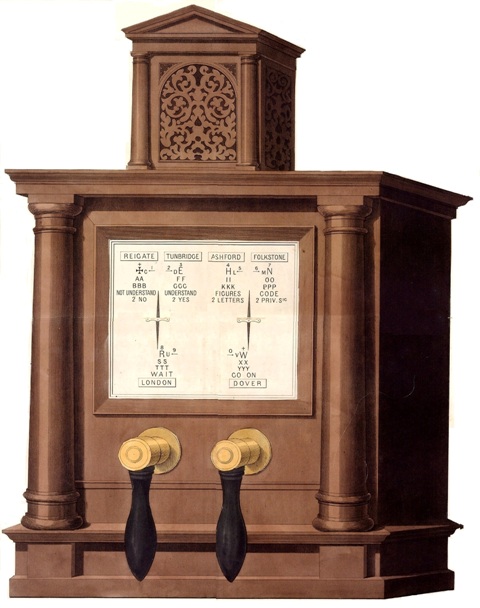
The Universal Telegraph The Communicator, pressing a key stopped the rotating needle Developing the Business Unlike in public telegraphy where Miles of Line are important in securing particular profitable routes and Miles of Wire are less so as they address capacity and to some extent are adjustable to suit demand – in private telegraphy Miles of Wire are the determining factor in the model. The more Miles of Wire that it rented out to private subscribers the greater its income will be; the private wire company must determine the optimum number of wires for any district that it intends to serve and ensure maximum uptake of those wires. The use of multi-strand cables was the key to effectiveness in this, rather than the multiple use of single iron wires.
The original costs for private telegraphy were similar to public telegraphs: in negotiating rights-of-way, paying wayleaves, and in constructing the lines.
The Universal Private Telegraph Company initiated two income streams; rentals from private wires and rental and sales of instruments. During 1861 and 1862 it had constructed ten aerial cables in London, each carrying from fifty to thirty circuits or “strands”, its marketing effort was in finding renters for each of these circuits. It planned to buy or lease houses at triangulation points across London to form secure places for the attachment of its aerial cables on their roof-tops and then let the premises to businesses or residents conditional on access to their circuits.
Even before the Company’s creation the Universal telegraph instruments had been installed on internal circuits at newspapers in London, by Reuter in his foreign news agency and by the City Police. The earliest new subscribers for rental of a private wire in London included, in April 1861, S W Silver & Company, Bishopsgate to Silvertown; Ravenhill & Salkeld, engineers and shipbuilders, Ratcliffe to Blackwall; the 'Daily Telegraph', Fleet Street to Russell Square (the owner’s residence) and the Thames Graving Dock Company, Silvertown; in September 1861, Pickford & Company and Chaplin & Horne, the carriers, and Bass & Company, the brewers, from their City premises to Camden Town railway goods depot; in March 1862, J Reuter, Royal Exchange Buildings to the offices of 'The Times', 'Daily Telegraph' and 'Morning Star' newspapers; and in July 1862, the Zoological Society of London, Middlesex Water Works and Price’s Patent Candle Company. It also listed John Penn, the ships’ engine builder, De la Rue & Company, the banknote and stamp printers, and Elkington & Company, the electroplaters, as clients in its first year, as well as other manufacturing and engineering firms in London.
From its commencement the Company had a strong interest from Glasgow; almost simultaneously with the cables in London a series of circuits were established in Scotland’s commercial and engineering capital. In September 1861 the City of Glasgow Police; Loch Katrine Waterworks; the city’s two gas-light companies; the Forth & Clyde Canal; Dalglish, Falconer & Company, calico printers; Henry Monteith & Company, dyers; G & J Burns, steamboat owners and engineers; A & A Galbraith, spinners and cloth manufacturers; Charles Tennant & Company, chemical manufacturers, David Hutcheson & Company, steamboat owners; Yates, Brown & Howat, muslin manufacturers; and many other mercantile, shipping and engineering firms were already subscribers. In October 1861 the Company was canvassing for private wire customers in Manchester, the centre of the cotton trade and manufacturing in Britain and was engaged in building its first aerial cables there. It appointed an Agent to solicit business on commission, Wheatley Kirk & Company, of Albert Street, St Mary’s, Manchester, ostensibly a firm of surveyors, valuers and auctioneers of factories, plant and machinery, who also engaged as “general dealers and chapmen”. Kirk, who styled himself “District Engineer & Agent”, for Manchester, Lancashire, Yorkshire, Cheshire and the Midland Counties, was to be found exhibiting the telegraph to trade associations in Manchester during 1861.
Nathaniel Holmes, the Company’s engineer, was the driving force in the initial development of the Universal company; he was to be found soliciting shareholders from the scientific and mercantile communities, touring the country in this role as well in engineering and managing its works. In 1862 he was travelling between London, Bristol, Newcastle, Birmingham, Glasgow and Liverpool and ran up £907 in costs and expenses.
Looking for major users, during 1861 Holmes provided a costing to the Government for private circuits in Whitehall to serve fifteen cabinet ministers; 19 instruments, 11 extra bells and 4 switches, totalling £337. In the same year he quoted the Metropolitan Police for circuits connecting Scotland Yard with the seventeen divisional chief offices and to the City Police; 21 instruments, 13 bells and 4 switches, at £335. Both of these projects were to be adopted in subsequent years in slightly modified forms.
However its activities were producing results, orders for private lines in June 1862 were: in Glasgow 37; in Manchester 54; in Liverpool 15 and new lines in London 20.
After a year’s construction activity the Company had achieved in September 26, 1862, in miles of wire constructed in cables and those miles of wire that it had found renters for:
London District 1862 Line A Finsbury – 30 miles, 9 ½ miles rented Line B Strand – 160 miles, 51 miles rented Line C Whitehall – 35 miles, 6 ½ miles rented Line D Camden – 76 miles, 17 miles rented Line E Oxford Street – 16 miles, 4 miles rented Line F Pimlico – 7 miles, 6 miles rented Line G Victoria Docks – 124 miles, 10 miles rented Line H Southwark – 13 miles, 3 ½ miles rented Line J Lambeth – 6 miles, 2 ½ miles rented Line K Wapping – 59 miles, 4 miles rented
This totalled 526 miles available in London. It then had 412 miles of spare capacity on London, but 35 ½ miles had applications from potential customers.
Glasgow District 1862 Line A – 29 miles Line B – 17 miles Line C – 38 miles Line D – 10miles Line E - Govan and Renfrew in progress Line F – 14 miles Line G – 69 miles
This totalled 177 miles of wire available in Glasgow.
Manchester District 1862
There were problems in developing the Manchester business. A long report to the Board of Directors noted that Bonelli’s Electric Telegraph Company and the Globe Telegraph Company were active in “tapping” its business. Their agent, Wheatley Kirk, had been dismissed but retained a stock of instruments and the books. Basil Holmes, the engineer’s brother, was appointed Local Secretary in his place. In response to the competition Holmes proposed, after negotiations with W H Preece, the Electric Telegraph Company’s District Superintendent, that extensions be immediately carried out using the Electric’s rights-of-way on existing overhead pole lines at 1s a mile wayleave, and through rental of wires where they were already up on an annual payment. These would consist of circuits 1] Manchester to Liverpool (6 wires); 2] Liverpool to Northwich (3 wires); 3] Manchester to Warrington (2 wires); 4] Manchester to Patricroft (4 wires); 5] Manchester to Bolton (4 wires), and 6] Manchester to Ashton and Stalybridge (2 wires). He also wished to acquire rights-of-way from Manchester to Stockport, Bolton to Bury and Rochdale, and Rochdale to Oldham and Ashton. This would rapidly extend the Company’s coverage of Manchester and Liverpool, which he felt could be quickly rented to private subscribers.
Extension in 1863 Nathaniel Holmes presented a series of maps to the Board of Directors in March 31, 1863 illustrating the aerial cables that the Company had erected:
• Manchester to Hyde, Stalybridge and Glossop • Manchester to Oldham • Manchester to Middleton, Bury, Haslingden, Accrington, Blackburn and Preston • Bury to Wigan and Blackburn
Cables in the Manchester district were planned from Middleton to Rochdale and from Manchester to Stockport.
• Glasgow to Partick • Glasgow to Campsie Junction and Kirkintilloch and Lennoxtown • Glasgow to Leven • Glasgow to Pollockshaws and Thornliebank with branches to Barrhead and Busby • Thornliebank to Paisley, Port Glasgow and Greenock, to Paisley and Dalry
A long cable was planned in the Glasgow district to connect with Edinburgh and Leith.
In the spring of 1863 the Company launched its services in Newcastle-upon-Tyne, the major centre for the coal-trade and for heavy engineering. In March 31, 1863 it planned three cables:
• Newcastle to Elswick and Scotswood • Newcastle to St Anthony, Willington, North Shields and Tynemouth • Newcastle to Gateshead, Friarsgoose, Jarrow and South Shields
In Newcastle the Universal Private Telegraph Company, at the instance of Nathaniel Holmes, took a time-signal from Edinburgh Observatory in Scotland and used Wheatstone’s magnetic exploders in its office at one o'clock each day to ignite the charges of “time-guns” at the Old Castle in the city and at Barrack Hill several miles away in North Shields, signalling the precise hour of the day as a public service. The Company's aerial cables had 50, 30, 20 or 15 copper cores dependent on the potential of the district through which they were to run. There were also single india-rubber insulated wires, and what the Company termed “open wires”, ordinary iron wire overhead circuits on earthenware insulators. “Open wires” were used primarily in their provincial lines. The iron wires caused problems for the Company: in a year of electrical storms throughout the country large numbers of instruments were “thrown out-of-order” and one clerk rendered senseless by lightning in Glasgow during February 4, 1863. The use of paratonnerres or lightning protectors was obviously not obligatory in the private circuits. Extensions in 1864 The Company opened 63 new private lines in 1864; new clients included Tupper & Company, William Cory & Son, South Kensington Museum, Victoria Dock Company, Odams Chemical Manure Company, Land Securities, Bryant & May, the Government’s India Stores, Kennard & Hankey, bankers, St Katharine’s Dock, Waterlow & Sons, London Dock Company and the Chartered Gaslight & Coke Company.
A private line was opened in 1864 to Professor Wheatstone’s home in Portland Place, off their aerial line to Finsbury. The Commissioner of Police for the Metropolis, Sir Richard Mayne, and the Assistant Commissioners, Captain William Harris and Captain Douglas Labourdiniere, then also had personal lines.
Names from the telegraphic past with private wires included Henry Brett, the gin and brandy distiller and father of John Watkins Brett, the submarine cable pioneer, and C W Tupper, the maker of the first iron wire circuits used in telegraphy by W F Cooke.
In that year the Company began replacing its india-rubber insulation with gutta-percha, changing their suppliers from S W Silver & Company to the Gutta-Percha Company. A fire at Silvertown on May 26, 1864 destroyed a large mileage of the Company’s newly-manufactured aerial cable.
The London lines had cost by December 1864 £16,574 to erect; the 596 miles of aerial cable at £19 3s 10d per mile of wire, the 135 miles of conventional “open wire” circuits cost £31 11s 2d per mile of wire.
The Newcastle District at the end of 1864 had 303 miles of wire, 138 in aerial cables and 165 miles of “open wire”. It possessed eleven lines: for Gosforth, North Shields, a Loop at North Shields, South Shields, the River Tyne, Northumberland Docks, Birtley and Chester-le-Street, Blyth, Low Walker, Whittledean and Sunderland. The lines at Blyth and Chester-le-Street were open for public traffic to Newcastle.
1865 New clients in 1865 totalled thirty-one in London and five in Newcastle, as well as others in Manchester. These included the Manchester Steel Company (owned by Joseph Whitworth), the Corporation of Salford (a local government authority), Shaw, Savill & Company (ship-owners), the 'Daily Telegraph' (2 more wires), the Birmingham Police, the Birmingham Gas Company and the 'Newcastle Daily Chronicle'.
Losses in wire renters in the later 1860s averaged at about ten a year.
The year 1865 also saw the completion of the Company’s major venture into public telegraphy which it called its Cantyre (Kintyre) Line, from Glasgow to Campbeltown on the Mull of Cantyre, to Oban, and to Rothesay in Scotland. Reid Brothers completed the 200 miles of pole telegraph for £6,244, as well as 5 miles of submarine cables across the lochs.
The Company began a dispute with Reid’s over their costs in that year. It had relied implicitly on its major suppliers for all of its supplies and services; its four offices each employed only four clerks who worked exceptionally long hours in keeping the books up to date. Colin Brodie began a test of direct labour and costed the processes involved in construction of its lines, and showed Reid’s charges to be excessive. By April 1866 the Company’s Miles of Wire in aerial cables and wires had expanded:
London District 1866 Line A - Finsbury, 42 miles Line B - Strand, 127 miles Line C - Whitehall, 27 miles Line D - Camden, 65 miles Line E - Oxford Street, 111 miles Line F - Pimlico, 15 miles Line G - Victoria Docks, 200 miles Line H - Southwark, 60 miles Line I - Lambeth, 11 miles Line K - Wapping, 91 miles
The District included Birmingham, with 15 miles, and Derby, Coventry, Bristol, Kendal and Dublin, 12 miles.
In 1866 the Company’s London District totalled 776 miles of wire; 629 miles in aerial cable and 146 miles in “open wire”.
In December 1866 two surgeons, Louis Little and John Couper, had the Universal company provide a three-mile long private wire and instruments to connect their rooms in Brook Street and Park Street in the West End with the 445 bed London Hospital on Whitechapel Road in the East End. They paid for this facility themselves so that they might be immediately summoned for emergency duties at the hospital.
At the end of the following year the Engineer’s report in December 1867 consisted of:
London District 1867 Line A – Finsbury [Birchin Lane, Founders’ Court, Moorgate Street, King Street, Wharf Road, Highbury] Line B – Strand [Birchin Lane, Lombard Street, Bedford Street, Tavistock Street, Adelaide Street] Line C – Whitehall [Parliament Street, Bridge Street, Clock Tower, House of Commons] Line D – Camden [Oxford Street, Goodge Street, Euston Station, Camden Station & Piccadilly Circus to Conduit Street] Line E – Oxford Street [Founders’ Court, Baker Street, Russell Square, Guildford Street] Line F – Pimlico [Victoria Street, Grosvenor Place, Halkin Street, Grafton Street, Chartered Gas Works, Thames Bank] Line G – Victoria Dock [Birchin Lane, Hayden Square, Mile End Gate, West India Dock, East India Dock, Orchard Street, Victoria Dock, Silvertown, Purfleet, Chartered Gas Works, Bow, Hackney Wick] Line H – Southwark [Hibernia Wharf, Hay’s Wharf, Free School Road, Dockhead, Wade Street, Spa Road, Deptford, China Hall, Rolt’s Yard] Line I – Lambeth [Belvedere Road] Line K – Wapping [King William Street, Adelaide Place, Nicholson’s Wharf, Wapping Basin, St Bede’s Wharf; and Custom House, Mincing Lane, London Road; and Minories, St Katharine’s Wharf, Broad Street, Ratcliffe]
In July 1868 a new 30 strand line was to be laid alongside of the South Eastern Railway from Cannon Street to St Saviour’s Church to Spa Road, Jamaica Road, Neckinger Road to Greenwich.
Outside of London itself the District in 1868 managed private lines in Birmingham, 27 miles, Derby, 1 mile, Coventry, 1 mile and Bristol, 1 mile, as well as 39 miles of Metropolitan Police lines.
Newcastle District Line A - Gosforth, 29 miles Line B – Tynemouth, 96 miles Line C – Jarrow, 60 miles Line D – Whittle, 29 miles Line E – Malhead, 13 miles Line F – Willington, 70 miles Line G – Percy Main, 3 miles Line H – Northumberland Dock, 5 miles Line I – Gateshead, 5 miles Line J - Town, 1 mile Line K - Durham, 54 miles Line L – Sunderland, 8 miles Line M – Chester-le-Street, 18 miles Line N – South Hetton, 28 miles Line O – Riddick House, 8 miles Line P – Miscellaneous, 7 miles Line Q – Stella Staith, 5 miles
Manchester District Line A – Wear Lane, 54 miles Line B – Studdart Bridge, 17 miles Line C – Blackburn, 129 miles Line D – Brealey, 13 miles Line E - Patricroft Line F – Beckton Hall, 5 miles Line G – Ashton, 52 miles Line H – Stockport, 12 miles Line I – Wanting, 17 miles Line J – Pendleton, 31 miles Line K – Jackson’s Row, 4 miles Line L – Miscellaneous, 4 miles Line M – Bradford, 7 miles Line N – Kendal, 3 miles
Liverpool Line A – Vauxhall Road, 23 miles Line B – Christian Street, 9 miles Line C – Prince’s Dock, 20 miles Line D – Canada Dock, 72 miles Line E – Sandy Lane, 3 miles
On December 31, 1868 the report to the Board of Directors showed that the Universal Private Telegraph Company possessed the following miles of wire:
1868..……London…….Manchester……Newcastle…….Glasgow……..Cantyre Built.…….826…………..579………………..432……………..603……………479 Building….20……………..8………………….44………………..29……………….0 Rented….573…………..467………………..384……………..510….…………402
The Company continued to invest in additional mileage, driven by continual demand for private circuits. In 1868, the year in which it achieved its best dividend return, its spare capacity still varied from 30% in London to 20% in Manchester, 10% in Newcastle and 15% in Glasgow. This gave it a large margin for expansion; and the original Universal telegraph and aerial cable patents still had five years before they expired and competition could enter the market.
Instruments From the beginning the Universal Private Telegraph Company classified its instruments as Communicators (transmitters), Indicators (receivers) and Bells (alarms). Each type had a separate number series in the Instrument Account. Originally they were separate instruments, but by 1863 Augustus Stroh had combined the Communicator and Indicator into a single instrument, with its own Bell. The functions continued to be accounted for individually as private users requested separated instruments, particularly more alarm bells. Also Wheatstone’s magnetic bells were used to provide acoustic signals in mines and factories, as they had on the railways previously. The Company also provided switches to combine more than one circuit and tested relatively complex switch-boards, designed by its engineer Colin Brodie, to interconnect multiple circuits. 
Wheatstone's Universal Telegraph 1859
The original Communicator or Transmitter October 1862…....…Coms…..…Indics…...…Bells London………………..136………...136………….145 Glasgow……………….114…………102………….105 Total……………………250…………238……….…250
September 1863......Coms…..…Indics…...…Bells London…………………212………..212…………..212 Manchester…………..99………….100………….106 Glasgow………………..200………..206…………208 Total…………………….511…..…….518………….526
June 1864………....…Coms…...….Indics….....Bells London…………………337………….337…………373 Newcastle……………..131…………..131…………155 Manchester…..………141…….…….142………...168 Glasgow………..………288…….……294…….…..301 Total…………………….897………….904………...997
December 1866….....Coms…...….Indics…....Bells London………………….516………….516…………600 Newcastle………………169………….169…………195 Manchester…………….229…………236…………296 Glasgow…………………372………….378…………390 Sales………………………117………….117……..….127 Stock…………………..……………………………………12 Total……………………..1,403……….1,416……….1,620
December 1868….....Coms…….....Indics…....Bells London………………….526…………..526………..645 Newcastle………………161……………161…………209 Manchester……………250…………..257…………326 Glasgow…………………395…………..401…………423 Sales……………………..181……………181………….208 Total……………………..1,513…………1,526..…….1,812
Curiously, the Company rented twenty-four Universal instruments to the competitive London District Telegraph Company for use on its own private circuits. The District’s contract with the Post Office, connecting its main sorting depots, was worked entirely with sixteen Universal telegraphs. Line rental was entirely separate from instrument rental, so users of a line could specify which type ought to be installed. 
Wheatstone's Universal Telegraph 1859 The original Indicator or Receiver with the Alarm in the base The Company had acquired the patent for the Universal telegraph outright in 1861. They bought all of their instruments, free-of-royalty, from Charles Wheatstone. Of the 1,500 instruments rented at the end of 1868 one third were to the original two-part design and the remainder to the unitary design of Augustus Stroh, on which they paid a royalty. The retail price of a Universal telegraph reduced considerably from its introduction when it was £36 for the two-part version. From 1865 to 1868 the one-piece telegraph varied in price between £25 for commercial customers to £20 for the War Office. As they cost £13 10s from the makers, the gross margin on these was in the region of 50%. The separate magnets-and-bells sold for £5 5s, and cost about £3. Of course, only a tiny proportion of instruments were sold outright, the overwhelming number were rented to subscribers.

Wheatstone's Universal Telegraph 1863 After Augustus Stroh put the sender, receiver and alarm in one case As Wheatstone used the Company as sales agent the difference in retail price and cost was divided equally between the two parties. Of more consequence in the long-term was the profit share that he received on all instrument rentals. In November 1862 the Universal company was also marketing Wheatstone’s “automatic printing telegraphs, alphabetical printing telegraphs, railway signal telegraphs and apparatus, mining telegraphs and exploding machines”. Construction Costs - Aerial cable 1862 1866 Iron Pole £11 10s £7 0s One span with insulation £1 5s £1 4s Brackets £1 0s 10s Leading down and fixing gutta-percha wire 6d 2d Suspending cables £1 0 s 12s 0d Suspending light cables 12s 0d 7s 6d Construction Costs - Road wire 1862 1866 Poles and one wire a mile £30 £20 Extra wire a mile £10 £8 Painting poles (two coats) 22s 6d 22s 6d
All of this work was undertaken by Reid Brothers of London, who also provided most of the materials.

A Connecting Box of the Universal Private Telegraph Company 1863 With one every mile on its aerial cables this shows the technical complexity of its urban circuits Before the Phone Book
To illustrate the nature and extent of private telegraphy the following is a selection of the subscribers to the Universal Private Telegraph Company at its hand-over to the Post Office in October 1870. The vast majority of its clients were merchants and traders who relied on communication for their livelihood, whose names have long been forgotten. The list demonstrates the variety and economic bias of users; how printers and heavy engineers found the Universal telegraph of utility, as well as the press, the police and other organisations with a branch structure. Those marked with an asterisk * had been subscribers in the previous year.
LONDON District - including Birmingham, Bristol and Coventry, with 570 Universal instruments Bank of London* Birmingham Gas Company Birmingham Police (3 circuits) Henry Brett (publican) (3 circuits) Bristol Police Bryant & May (match-makers) Joseph Causton (printers) Chaplin & Horne (carriers) (2 circuits) Chartered Gas Company Chubb & Company (lock-makers) City of London Union (local government) Coal Factors Society (Coal Exchange to Victoria Dock) William Cory (coal-factors) (4 circuits) Cross & Blackwell (pickle-makers) Daily News newspaper Daily Telegraph newspaper De La Rue & Company (printers) The Echo newspaper Eyre & Spottiswoode (printers) Great Eastern Railway Hay’s Wharf (wharfingers) India Rubber, Gutta Percha & Telegraph Works Johnson & Matthey (precious metal refiners)* Kennard & Hankey (bankers)* Land Securities Company (mortgage bank) Licensed Victuallers Tea Association Lord Londesbury London Joint Stock Bank (3 circuits) London & St Katherine Dock Company (10 circuits) London & South-Western Bank London & Westminster Bank (7 circuits) London Joint Stock Bank* London, Windsor & Greenwich Hotel Company James McHenry (financier)* Dr Mackenzie of the Throat Hospital (3 circuits) Mappin & Webb (jewellers) Marylebone Vestry (local government) Metropolitan Police (24 circuits) Midland Railway Millwall Dock Company Samuel Montagu & Company (bankers)* Morning Post newspaper National Bank (7 circuits) Negretti & Zambra (instrument-makers) (3 circuits) Pall Mall Gazette newspaper Peek Frean & Company (biscuit-makers) Pickford & Company (carriers) (4 circuits) Price’s Patent Candle Company* Ravenhill & Salkeld (engineers) Regent’s Canal Company (2 circuits) Reid Brothers for the City Police (9 circuits) J & G Rennie & Company (engineers) Reuter’s Telegram Company* Salvage Association (ship-salvors) Shaw, Savill & Company (ship-owners) S W Silver & Company South Kensington Museum (The V&A)* Sovereign Life Assurance Company Spottiswoode & Company (printers) (3 circuits) The Standard newspaper Surrey Commercial Dock Company The Times newspaper Trinity House (lighthouses) Union Bank of London* Victoria Dock Company* Waterlow & Sons (printers) Westminster Palace Hotel Company Zoological Society of London (The Zoo)
MANCHESTER District - including Barnsley, Blackburn, Bradford, Hull, Kendal, Oldham, Leeds, Liverpool, Salford, Sheffield and Wigan with 287 Universal instruments Liverpool Gas Company (4 circuits) Liverpool, New York & Philadelphia Steam Ship Company (Inman Line) Liverpool Police (22 circuits) David McIver & Company (Cunard Line) (5 circuits) Manchester & County Bank* Manchester Police (10 circuits) Manchester Steel Company* Mersey Docks & Harbour Board (10 circuits) National Steam Navigation Company Oldham Corporation Gas Works Salford Corporation (local government) Salford Gas Company Salford Police West India & Pacific Steam Ship Company Wigan Coal & Iron Company (5 circuits)
NEWCASTLE District - including Sunderland, with 160 instruments W G Armstrong & Company (engineers) (2 circuits) Backworth Coal Company (2 circuits) Bedlington Coal Company (2 circuits) Birtley Iron Company Black Boy Coal Company Burnhope Coal Company County of Northumberland Police Cramlington Coal Company Earl of Durham (coal-owner) Cowpen & North Seaton Coal Company (4 circuits) Hetton Coal Company (2 circuits) W Hunter (coal-owner) (4 circuits) Jarrow Chemical Company James Joicey & Company (coal-owners) (4 circuits) Newcastle Police (5 circuits) Newcastle & Gateshead Water Company Newcastle Gas Company North Hetton Coal Company North Bitchburn Coal Company J M Ogden (coal-owner) (3 circuits) Ryhope Coal Company Seaton Delaval Coal Company (3 circuits) South Hetton Coal Company (3 circuits) Stella Coal Company W Stephenson & Sons (coal-owners) (3 circuits) Tharsis Sulphur & Copper Company (copper smelters) Earl Vane (coal-owner) (5 circuits) Weardale Iron Company
GLASGOW District – including Edinburgh and Dundee, with 254 Universal instruments Barclay, Curle & Company (engineers) Barony Parochial Board (local government) Blochairn Iron Company G & J Burns (ship-owners) (2 circuits) Caird & Company (engineers) Clyde Shipping Company Clyde Trustees (local government) Duke Street Prison Board Dundee Police Edinburgh Police (5 circuits) John Elder & Company (engineers) (4 circuits) Forth & Clyde Canal Company (6 circuits) Garnkirk Canal Company Glasgow Corporation (local government) Glasgow Gas Commissioners Glasgow Corporation Gas Company (3 circuits) Glasgow Daily Mail newspaper Glasgow Exchange Committee (stock market) Glasgow Iron Company Glasgow Jute Company (3 circuits) Glasgow Police (12 circuits, including the Prison) Glasgow Water Commissioners (3 circuits) Glasgow & Greenock Shipping Company Glasgow, Paisley & Ardrossen Shipping Company Gourock Rope Works Company Greenock Foundry Company Handyside & Henderson (Anchor Line) London & Glasgow Engineering Company Robert Napier & Sons (engineers) (3 circuits) National Bank of Scotland* North British Railway (3 circuits) The Scotsman newspaper J & G Thomson (engineers) Tod & McGregor (engineers) (2 circuits) J E Walker (3 circuits) Wylie & Lochhead (furniture makers) (3 circuits) Young’s Paraffin Oil Company (3 circuits)
IRELAND – managed from London, including Dublin and Belfast, with 55 universal instruments Alliance Gas Company, Dublin Lagan Foundry Guinness & Company (brewers) (2 circuits) Melfort Spinning Company Milewater Spinning Company Ulster Spinning Company White Abbey Spinning Company White Abbey Bleaching Company Irish Times newspaper
The universal telegraph was adopted in public service by several of the British-owned cable companies that operated overseas. It was used on the land circuit between the cable’s coastal shore-end station with its specialised apparatus and the public offices in foreign city centres. In addition the Electric Telegraph Company acquired several for its own use and for use on the private circuits that it worked.
Outside of London and other cities, the country houses of the political, mercantile and commercial classes were put in circuit with their nearest telegraph office. Lord Kinnaird had the Universal company install a private circuit from Rossie Castle in Forfarshire to the nearest town, Montrose, a distance of eight miles.
Summary The Universal company was a successful venture, continually expanding its mileage and rentals in the relatively small field of private telegraphy– eventually paying 8% dividends in 1868. In 1866 it had 6,340 shares on which £105,026 was paid-up; the largest shareholder was Charles Wheatstone with 566 shares, £13,080 paid. It should not have been acquired by the state in 1868 as, with odd exceptions, it did not offer a public service. However it was pointed out that, as the odd exceptions proved, unless it was taken into state ownership nothing could prevent it opening other public lines. The following tables show the gradual but continual expansion of the Universal Private Telegraph Company during its mature phase as compiled by its engineer Colin Brodie in 1871 for its administrators; they differ slightly from those produced earlier by Nathaniel Holmes. The figures are divided between the Company’s districts, London, Manchester, Newcastle and Glasgow; these effectively covered the whole of Great Britain and Ireland.
Miles of Wire Rented ……………London…….Manchester……Newcastle…….Glasgow 1863…….227…………..110………………..100 ……………..245 1864…….364…………..228……………….191………………358 1865…….445…………..329……………….264……………..369 1866…….504…………..380………………309……………...448 1867…….576…………...462………………326………………485 1868…….598…………..441……………….379………………490
Rental Income from Wire £…………London…….Manchester……Newcastle…….Glasgow 1863……916…………..352………………..380……………..779 1864……1,778………..665………………..752……………..1,138 1865……2,512………..1,079……………..1,133……………1,199 1866……3,029……….1,389……………..1,368…………..1,382 1867……3,875………..1,652……………..1,521…………...1,654 1868……4,158………..1,914……………..1,876……………1,757
Expended on Lines £…………London…….Manchester……Newcastle……Glasgow 1863……12,540………6,041……………..4,060…………8,892 1864……16,665………7,680……………..6,286………….11,422 1865…….17,802……..8,745……………..7,941…………..11,771 1866…….18,594……..9,919……………..8,383…………..12,009 1867…….20,660……..10,571……………8,788…………..11,892 1868…….20,930……..10,630…………..9,417…………..12,113
The dividends were 1863 - 5%; 1864 - 6%; 1865 - 6%; 1866 - 0%; 1867 - 4%; and 1868 - 8%.
In 1868 the Universal Private Telegraph Company had a total paid-up capital of £121,463. The Company then employed 18 clerks, and 6 messengers. Its public circuits in Scotland and North East England worked 27,542 inland messages.
The Post Office took over 1,196 miles of private wire and 400 miles of public wire (139 miles of public line), and 1,466 Universal instruments that the Company had provided to its subscribers; these figures are significantly lower than those recorded in the firm’s books or returned to the Board of Trade in previous years. The Government acquired the patent for the Universal telegraph along with the other assets of the Company; it immediately renamed it the “ABC telegraph” to ensure that its true purpose was concealed. In 1870, with the capital obtained from the government appropriation, Wheatstone established the British Telegraph Manufactory to make his telegraph instruments, clocks and exploders. For this he acquired the former premises of Cornelius Ward in Great Portland Street, London; a man who, like himself, had been a patentee and maker of musical instruments. 
The West Highland Telegraph The Universal company, with the permission of the Electric Telegraph Company, entered public telegraphy in 1865, with a series of wires from Glasgow to North-West Scotland which it called its “Cantyre Line”, trading as the West Highland Telegraph. The area was a stronghold of the British & Irish Magnetic Telegraph Company and of railway-operated telegraphs worked in concert with the Magnetic. It inherited the rights of the abortive Glasgow, Cantyre & General Telegraph Company of 1864, established to connect several lighthouses on the Clyde river with Glasgow port through a local land network and eight submarine cables.
It eventually worked ten public circuits, all constructed by Reid Brothers of London for a total of £6,244, from its office at St Vincent Place, Glasgow, to:-
1 Campbeltown 2 Oban 3 Rothesay 4 Dunoon 5 Roseneath 6 Greenock 7 Partick 8 Hillhead 9 Govan 10 Bridge Street Station
The circuits were almost entirely “open wire”, in the Company’s terminology, consisting of iron wires on overhead poles; but they also included four short submarine cables across the lochs at Roseneath, Blairmore, West Craighead and Ardbeg. In length the circuits totalled 230 miles of line, of which 5 miles were underwater and a short length underground through Helensburgh. Its Cantyre lines ran from the centre of Glasgow along the north bank of the Clyde river to Helensburgh, Row, Roseneath, Blairmore, Cot House and East Craighead to West Craighead; West Craighead north along the road around Loch Awe to Inverary and Oban; West Craighead south down the Cantyre peninsular to Ardrishaig, Campbeltown and the Cantyre Light on the tip of the Mull; and from Cot House south past Holy Loch along the west bank of the Clyde to Dunoon, Toward, Ardrie Point, Ardbeg and Rothesay. To these dedicated lines it also applied wires in its private circuits to Barrhead and Greenock to public use.
The 13o mile long line to Campbeltown and a private wire on to the light house on the Mull marking the start of the shipping route into the Clyde was completed on September 4, 1865.
The network of the West Highland Telegraph was a rural, even rustic, “self-help” operation, relying on the goodwill of the local inhabitants in providing access and services on a voluntary basis. There were twenty-six public offices, all run by Agents of the Universal company from their shops or homes, without charging rent or other expenses. Outside of the larger villages, their friends and children delivered messages. Its circuits were worked with the Universal telegraph by ordinary people with minimal training; they sent their takings weekly to Glasgow.
The location of the stations and their working Agents were: Ardrishaig – Mr McCulloch; Barrhead – Mr Watson, Post Office; Blairmore – Mr McLeish, grocer; Bowling – Mr Jeffrey; Campbeltown – Alex McEwing, stationer; Carradale – Mr Steel, forester; Cove or Craigrownie – Mr Harris, Post Office; Dumbarton – Mr Blair, Post Office; Dunoon – Mr McLeod, Parochial Poor Inspector; Glasgow, 11 St Vincent Place; Glasgow, Bridge Street Station, newspaper stall; Glasgow, Charing Cross - Mr Littlejohn, wine merchant; Govan – Mr Harl, druggist; Greenock – Mr Kinloch, stationer; Helensburgh – Mr Bartrum, bookseller; Hillhead – Mr Stenhouse, Post Office; Innellen – Mr Sheare, Innellen Hotel; Inverary – Mr Rose, Post Office; Lochgilphead – Miss Miller, Post Office; Minard – Miss Smith; Oban – John Hunter, apothecary; Partick – Mr Kennedy, bookseller; Roseneath – Robert Morrison, grocer; Rothesay – Mr McKinlay, Post Office; Tarbert – Mr McCalman, banker; and Toward – Mr Wright, carpenter.
The degree of self-help was such that a guarantee of £40 per annum was offered from April 1866 by John Pender (of the British & Irish Magnetic Telegraph Company) who had his country-house close-by at Minard Castle to support the Minard office.
Circuits in the Universal Private Telegraph Company's private lines from Blyth, Chester-le-Street and Sunderland to Newcastle in North-East England were also open for public use. As with its Cantyre Line these were worked by third-party Agents, not by Company employees, who remitted telegraph money to the District office in Newcastle.
Copying the national telegraph companies the Universal company’s agents sold Telegraph Stamps, in two denominations, 6d and 1s 0d, to encourage its public business in Scotland and the north of England. The Company apparently charged 1s 0d for a twenty word message, and 6d for each subsequent ten words or less. Other Companies’ Private Circuits
As well the Universal firm, private telegraphy between offices and individuals was offered by all of the other telegraph companies; to the extent of 1,329 miles of private wire with 307 instruments in 1868. In addition there were leased-lines provided for newspapers in Scotland and the north of England to transmit copy from London during the night, but these were worked between the telegraph companies’ offices.
At the end of its existence the Electric Telegraph Company worked the following circuits on behalf of individuals and public bodies. These principally divide into Government work, the transmission of time, leased lines for the press and private contracts ante-dating the formation of the Universal company.
Admiralty (4 circuits) Astronomer Royal (time signal) Duke of Beaufort J Bennett, London (time signal) Blair, London (time signal) Cammell & Company, Sheffield (steel-makers, 3 circuits) Clay Cross Colliery Company (3 circuits) House of Commons to Lothbury Copper Miners Company E Dent, London (time signal) East India Docks Company Falmouth, Gibraltar & Malta Telegraph Company Glamorgan County Gaol Glasgow Daily Mail newspaper Glasgow Herald newspaper Great Eastern Railway Great Northern Railway Hill & Price, Bristol (time signal) A Johannsen, London (time signal) London, Chatham & Dover Railway (time signal) London & St Katherine’s Dock Company (3 circuits, others with the Universal company) Lord Chamberlain (2 circuits, Windsor Castle and Buckingham Palace) Military Storekeeper to Woolwich Arsenal J Pool, London (time signal) Steer, Derby (time signal) Lords of the Treasury (5 circuits, Balmoral Castle, Somerset House, Buckingham Palace, Foreign Office and Downing Street) Prince of Wales, Sandringham Vickers & Sons (engineers) War Office to Woolwich Arsenal Weichert, Cardiff (time signal) Wigan Coal & Iron Company (7 circuits, and others with the Universal company)E A Williams, Cardiff (time signal)
Regarding the other national companies: the British & Irish Magnetic Telegraph Company worked a very small number of private wires for the Admiralty, in the mining district of North-West England and in Dublin, Ireland. The United Kingdom Electric Telegraph Company also provided the Bridgwater Navigation and other canal companies with some private circuits. To work its private circuits for the dock companies, the War Office, the Post Office, the Metropolitan Fire Brigade, the Metropolitan Board of Works, and others, the London District Telegraph Company possessed 118 Siemens magneto-dial telegraphs in 1870, as well as twenty-four Universal telegraph instruments. There were several “non-starters” in private telegraphy inspired by success of the Universal telegraph, particularly in Manchester, the country’s immensely wealthy textile capital. W T Henley, the telegraph contractor, advertised his own magneto-dial telegraph, “the cheapest and simplest in construction”, in Manchester briefly in 1861, apparently in concert with Magnetic Telegraph Company. The Globe Telegraph Company of 1861 with Wilde’s instrument and the Economic Telegraph Company of 1864 with Breguet’s apparatus, both were promoted, obtaining Acts of Parliament, solely to provide private circuits in ‘Cottonopolis’. The General Private Telegraph Company was formed as a contracting firm during in 1866 for private wires in that city using the Breguet device. It also worked its own circuits along the Manchester, South Junction & Altrincham Railway, from the city centre to Stretford, Sale, Timperley, Altrincham, Bowdon and Lymm.
The telegraph companies collectively provided 1,773 instruments for private and government use in 1868. Other than the dial apparatus supplied by the Universal (which provided 80% of private equipment) and London District companies these were single-needle telegraphs, Cooke & Wheatstone’s or Highton’s, which required trained clerks for their working and batteries of acid-filled cells.
Separately from the public companies, telegraph contractors also offered to erect private wires for internal circuits in large factories, collieries and metal mines during the 1860s. The commonest instrument used in these indoor lines was Louis Breguet’s galvanic dial telegraph of 1852, which, although large in size and requiring batteries, could be used by ordinary clerks as it indicated the common alphabet. It had the commercial advantage of not being patented in Britain.
 “Albert, We have mail…”
|