THE ELECTRIC TELEGRAPH COMPANY

The monogram of the Electric Telegraph Company
On September 7, 1845 a syndicate led by the Ricardo family of City merchants projected a joint-stock company to purchase all the patents Cooke and Wheatstone had obtained to date and to provide capital for their more effective working, particularly to gain an income from public messages through a national network of telegraph lines. This created The Electric Telegraph Company – the first joint-stock concern in the world to operate a network of electric communications. It had a short life of just over twenty years. In that time it united electrically not just the entire country but, with its corporate allies, reached the extremes of empire.
The first Board of Directors of the Electric Telegraph Company comprised John Lewis Ricardo, the chairman, Samson Ricardo, William Fothergill Cooke, George Parker Bidder and Richard Till. These five were also the largest shareholders in the company, and were to stay in post for over ten years.
Cooke had agreed, prior to the establishment of the Company, to finance the expansion of the telegraph by assigning the majority of his patent rights to J L Ricardo and G P Bidder. This assignment valued Ricardo’s share at £60,000 and Bidder’s at £55,000, in addition to Cooke’s minority at £45,000.
Table 1 The Value of Cooke & Wheatstone’s Business According to W F Cooke in 1855
The business acquired by the Electric Telegraph Company consisted of twelve domestic and foreign patents, Cooke’s telegraph contracting business, the existing contracts and the materials on hand for future works.
Paid by the Company……………………150,000 Less unrealised contract…………………...8,600 Total………………………………………….£141,400
To Wheatstone………………………………30,000 To Lancaster for Irish rights……………...5,217 To Materials and for other rights……...10,117 To Cooke In Cash immediately………………………..2,566 In Cash by future profits………………...48,000 In 1,820 shares each of £100, at £25 paid…………………………...45,500 Total………………………………………….£141,400
As can be seen Cooke received £50,000 and Wheatstone £30,000 in cash. Cooke’s additional 1,820 shares could not be sold for several years and he was obligated to the Company to pay the balance of calls, £75 per share. Wheatstone was paid £20,000 in commutation of his royalty rights and £10,000 for his share in the Scottish, Irish and Belgian patents.
Regarding the directors; the firm of J & S Ricardo & Company of 11 Angel Court, Bank, were originally merchants in the Spanish trade, but in the 1840s and 1850s had become deeply engaged in financial and political affairs; investing in foreign stocks and railways. Richard Till, a lawyer, of Guildhall Buildings, City, had been Secretary of the London & Birmingham Railway and was to have a similar role in many of the railway concerns that G P Bidder had influence in.
Whilst W F Cooke had become a skilled user of the public press, the Company released very little information over and above its very modest legal requirements. After 1849 it resisted all enquiries by outsiders as to its business; such information as became available was through Government returns (which it completed only sporadically), from its competitors and from its associates. The Company proved to be a remarkably secretive concern. So much so that when the government took over in 1868 the board of directors, apparently, ordered the destruction of all of its historic documents, records and files. This accounts in someway for this work.
The new Company adopted as its motto the curious Latin sentiment Ne tentes, aut perfice – which very loosely translates as “succeed or do not try”. Indeed it tried, tried hard for twenty years; it succeeded and was well rewarded for that success.
The proprietors of the Electric Telegraph Company obtained an Act of Parliament on June 18, 1846 to raise the considerable joint-stock capital of £600,000 in £100 shares (on which only one-quarter, £25 per share, was to be paid-up immediately) to buy out the patent rights of both Cooke and Wheatstone, to finance their exploitation and the construction of telegraph lines across the country, with, among other legal powers, the right to lay wire over public property, especially railways.
The Electric Telegraph Company’s Act of Parliament had several clauses that set a precedent for working electric communication; its circuits had to be open for the sending and receiving messages by all persons alike, without favour or precedence, subject to a prior right of use for the service of the Government, and subject to such charges and regulations as the Company might make. However, when challenged in the Courts for giving preference to messages for The Times newspaper over those for the Morning Herald in 1850 the Company rejoined successfully that the Times paid more for securing the preference. It had powers to purchase patents, not just those of Cooke and Wheatstone, which would otherwise have been illegal under the ancient Acts for preventing monopolies in trade. Unusually the Act allowed the Company to apply to the Government to have the duration of its patents extended over the usual fourteen years. The Courts later rejected the Company’s application to extend these monopoly rights.
The Act also indemnified the Company against the negligence and carelessness of its officers and employees in the transmission and receipt of public messages. This indemnity against the results of errors in messaging was periodically challenged in the Courts; to no avail. The Electric company and its competitors were careful in ensuring that all messages were sent on forms that spelt out their legal protection, and that they all offered insurance against loss – at extra cost.
The Government insisted that the Company be obliged to grant a license to anyone named by the Privy Council to construct and use a telegraph for official service. In addition every telegraph line had to be open “at all reasonable times” for the transmission of intelligence for Government service, and all such messages had to have priority over all others, even to the extent of stopping other traffic. In emergency any one of the Secretaries of State, the most senior Government ministers, could take possession of the Company’s entire telegraph system for one week, and on a week-by-week basis subsequently, paying the Company the average weekly earnings for such seizure. When the Home Secretary implemented the latter requirement in 1848 during the Chartist emergency the charges were such as to give the Government second-thoughts about using the powers again.
From its commencement it intended to be a national enterprise, connecting the major cities and towns of the country by electric telegraph. After absorbing the original line to Southampton, the first long circuit it constructed was north alongside of the railway from London to the major manufacturing town of Birmingham, which it completed in mid-1847. This line was continued north to reach the industrial city of Manchester on November 14, 1847.
As with the partnership the Company’s initial income was to be derived from granting licences for use of the patents and from erecting lines; however in addition it anticipated substantial revenues from working public telegraphs, sending and receiving messages nationwide. That was an anticipation only slowly fulfilled.
On its inception the Company also intended to create workshops in London for manufacturing instruments to Cooke & Wheatstone’s patents, as well as other apparatus, such as electric clocks.
With the sole exception of the recently completed circuits on the South Eastern company (London to Dover, the seaport for France), an exception that was to have considerable consequences, the railway companies agreed to transfer their rights and leases with Cooke & Wheatstone to the new concern. Although the Company immediately advertised the lease of rights to third parties none were granted for public telegraphy.
The year turned out not a good one to launch a new concern. It was promoted in the middle of the great twelve-month Railway Mania in Britain that took hundreds of millions out of the economy for a massive burst of speculative investment, most of it found on credit. Like the house of cards falling, this was to be followed by a money panic in the City of London as common commercial credit dried-up; then by a food panic as the corn import trade was affected by the failure of credit and by the Europe-wide destruction of the potato crop through disease. All this was compounded by revolutionary unrest in France, Belgium and the German states in 1848, damaging continental trade. To cap it all the United States mounted an unprovoked invasion of Mexico disrupting Atlantic commerce with both countries. The five years between 1845 and 1850 were to be some of the most difficult for trade and business in the century, and it was to be so for the new Electric Telegraph Company.
Table 2 The Telegraph and the Railways in 1846 Miles of Telegraph Line in Operation Compiled by Henry Tuck for The Railway Shareholder’s Manual 1847
Company…………………….....………...……….Miles South Eastern Railway……………...…………124 Great Western Railway………………..……...18 London & South Western Railway………….94 Midland Railway…………………………….......251 Eastern Counties Railway………………..…...169 York & North Midland Railway……….…….106 Norfolk Railway……………………………........58 York & Newcastle Railway………………...…103
London & Croydon Railway……………..…..10* London & North Western Railway (Wolverton to Peterborough)……….……..54* London & Blackwall Railway…………..……4* Sheffield & Manchester Railway……………3* Preston & Wyre Railway…………………...…20* South Devon Railway……………………...….15* Eastern Union Railway…………………..…...16* North British Railway……………………...….2*
TOTAL………………………………..........……...1,048
* The telegraph used for railway signalling only The year 1846 was the first year of operation of the Electric Telegraph Company: only eight of the sixteen railway companies contracted offered public telegraphy and these in isolated local networks. There were as yet no circuits from London to the cities in the north or west of Britain, only to the south and east.
But there was a slow recovery. The strength of the British economy was such that it survived the Railway Mania, the money and the food panics with relative ease; although the reliance in Ireland on the potato crop was devastating to its population and that island’s economy. The emergence of Louis Napoleon in 1848 and the subsequent creation of the Second Empire in France in 1852 stabilised the rest of Europe and restored economic harmony. The American war on Mexico was as short as it was brutal and its immediate effects on trade were equally brief. This stabilisation was assisted by the economic impact of immense new gold imports into Europe from California and Australia. The Electric Telegraph Company’s first five years were ones of negotiation and construction; making deals for access rights or wayleaves, building overhead lines, training and employing clerks, and opening stations, as well as promoting the new medium to the public. A great deal of money was expended in a short time; but revenues grew slowly.
Only in 1849 when the skeleton of the national network was completed could the telegraph be said to be secure as a business.
By 1850 there was a new energy and a new confidence about that Britain in particular benefited from. It was from this year that the electric telegraph grew in manifold degrees.
W F Cooke was elected to the first board of directors of the Electric Telegraph Company and remained with it until the end. In the earliest years of the Company he was effectively the managing director and implemented its initial burst of negotiations and line-laying. But once it was perceived that the costs of this expansion were getting out-of-hand the board had eased Cooke, unwillingly, into a less involved role by 1850.
The partnership between Cook and Wheatstone had always been fraught and so it is no surprise to record that Wheatstone continued his life at King’s College, London, and played no part in its management. Although he was frequently consulted by the Company in its early years Wheatstone had no contractual arrangement. He was in litigation with Alexander Bain over the patent for the electric clock, with whom the Company had already come to an arrangement and made a director; Wheatstone felt that his own employment in such circumstances would be prejudicial.
Much more was to be heard of the professor and his electrical innovations in the next twenty years. It was through his continued input, inspiration and co-operation with others that the Company maintained a technical superiority, not just in Britain but worldwide.
The Company’s Patents - The Cooke & Wheatstone patents applicable in Britain acquired by the Company, there were six in all, both joint and individual, not only covered the principle of the electric telegraph in the initial master patent (although in that they claimed “improvements” and not “invention”) but also a large number of technical innovations. Their telegraph patents subsequent to 1838 included a range of needle instruments, dial instruments, printing instruments, circuit ‘bridges’, the ‘detector’ for determining circuit breakage, overhead poles in wood and metal, overhead insulators, underground wires, lead sheathing and just about everything else required to create a comprehensive telegraphic system. By and large Wheatstone originated the ‘electrical’ elements, instruments and such like. W F Cooke devised the ‘technical’ elements, the methods for the making of the line and rationalised Wheatstone’s apparatus into a commercial reality.

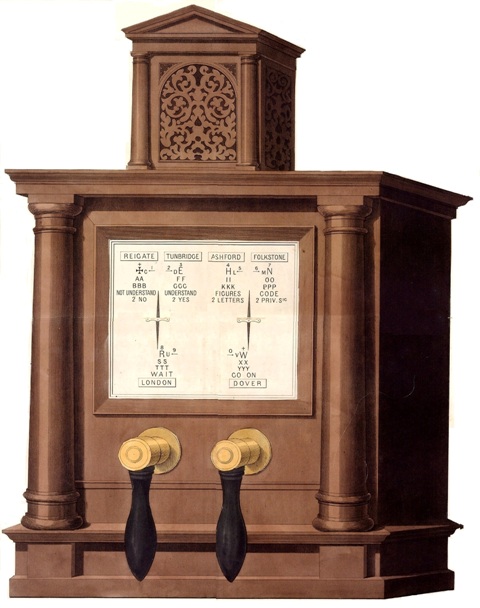
Cooke & Wheatstone's double-needle telegraph As well as the patents of Cooke and Wheatstone the Electric Telegraph Company, between 1846 and 1850, acquired an expensive suite of other telegraphic and electrical patents, pre-existing and new, that served to protect its commercial interests – that is, preventing others using them in alternate circuits. The ‘relay’ or ‘repeater’ of Edward Davy of 1838 essential for extending the length of the electrical circuit, the chemical telegraph of Alexander Bain of 1848 which ‘wrote’ a mark on treated paper, as well as several improved insulators for its poles, were purchased and used in its circuits, and oddities such as Charles Massi’s “percolating battery” of 1847, which it did not even utilise.
By April 1848 the Company, in addition to Cooke & Wheatstone’s two-needle apparatus, had installed the Bain writer on separate electrical circuits between London and Birmingham (112 miles) and Liverpool and Manchester (32 miles), and a direct Bain circuit was just about to be opened from London to Liverpool (226 miles). The Bain chemical writer was the British equivalent of the American telegraph, using a key to record marks on a distant moving strip of paper, and was used by the Company for volume traffic.
Among the other patents acquired from Alexander Bain was that for his Electric Clock, which the Company intended to manufacture and used at most of its principal stations for time-keeping and as a publicity tool. The spread of these remarkable timepieces was unfortunately limited by the disinterest of the Electric company in their manufacture and marketing after 1849. Bain later bought back the clock patent.
Cooke & Wheatstone’s patents applied fully only in England and Wales. Different patents applied in the two other kingdoms, Scotland and Ireland. This allowed the Edinburgh & Glasgow Railway (which was soon to become the North British Railway) to install Alexander Bain’s instruments on Cooke & Wheatstone’s line in 1844. It used Bain’s so-called “I & V telegraph”, a simple single-needle device. The Company acquired the wayleave along with Bain’s other rights in 1846, immediately replacing his apparatus with Cooke & Wheatstone two-needle instruments.
In 1847 the Company sued the proprietors of and eventually acquired the rights to Nott & Gamble’s widely-publicized telegraph, simply to suppress it; and bought Little’s telegraph patent in 1850 with the same negative intent. It had also acquired Henry Highton’s ‘gold-leaf’ telegraph and Henry Mapple’s electric alarm in 1846 as part of its policy of excluding others from its market.
The Electric Telegraph Company initially opened two public offices in London in 1846, one at 64 Moorgate Street in the City, its administrative headquarters at the heart of the financial and commercial district, and the other, its principal station, at 345 Strand, in the retail and residential West End, planning to connect these stations to the lines emanating out from the railway termini, hence to the rest of the country. As a publicity exercise a model room was set up in the Strand office to demonstrate the many instruments that then existed for telegraphy; including an acoustic or bell telegraph devised by Wheatstone, inventions by its own engineers and by other patentees, as well as instruments that printed both code and letters of the alphabet. It also showed electric ‘master’ clocks to Bain’s patent, which it advertised for sale to the public at £16 16s, with extra ‘slave’ dials, connected electrically, at £10 10s each.
In addition it had a fine subscription news-room opposite of its West End office, upstairs at 142 Strand, “a spacious and unusually superior first-floor, in the most central part of the Strand, consisting of four rooms (one of which was 24 feet by 20 feet), lighted with gas and having a fine entrance Hall”. The premises had been built in 1838 as the ‘New Turk’s Head Coffee House & Hotel’. The building had a broad shop front at ground level, occupied by John Chapman, the publisher, with two wide doors at either side, and four storeys. It was a full storey higher than the rest of the houses. The Strand, the main thoroughfare between the City with its business connections and Westminster, the centre of Government, was called by Benjamin Disraeli at the time ‘the first street in Europe’.
The Company’s first underground telegraph circuit was laid in 1845 beneath street footpaths to connect the Strand offices with the South-Western Railway’s overhead wires at Nine Elms station; it was a substantial cable containing two sets of four copper wires insulated with tarred yarn having a protective casing or sheath of thin lead, as patented by W F Cooke, and a thick hemp cover to counter abrasion, led though a 4-inch diameter cast-iron pipe.
As has already been said, with adequate capital assured the next four years saw a remarkable growth in connections and coverage, though not a comparable growth in dividends. The Company continued to use Wheatstone’s two-needle telegraph, Cooke’s overhead suspension system with its earthenware “barrel” insulators in all of its circuits, and long-distance rights-of-way negotiated with the railway companies.
Overseas, the Electric Telegraph Company acquired of Cooke & Wheatstone their rights in Belgium for the 30 mile overhead-wire line between the cities of Brussels, Malines and Antwerp alongside of the railway and opened the circuit on September 9, 1846 in their own name. It had telegraph offices in the centres of Brussels and Antwerp as well as at the railway stations, equipped with the two-needle apparatus. The Belgian Government bought-out the concession in September 1850 when they anticipated that telegraphy could be a viable, revenue-earning enterprise.
Two years of immense effort saw the construction of 2,000 miles of line connecting sixty major cities: London, Manchester, Glasgow, Liverpool, Edinburgh, Leeds, Sheffield, Birmingham, Bristol, Newcastle, Hull, Wolverhampton, Wakefield, Derby, Leicester, Norwich, Nottingham, Portsmouth, Northampton, Bradford, Coventry, Dover, Canterbury, Halifax, Rochdale, Maidstone, Southampton, Gloucester, Cheltenham, Yarmouth, Cambridge, Colchester, Ipswich, York, Darlington, Margate, Stafford, Barnsley, Hertford, Ramsgate, Deal, Folkestone, Rotherham, Tunbridge, Winchester, Dorchester, Peterborough, Huntingdon, Chesterfield, Wisbeach, Lowestoft, Chelmsford, Berwick, Scarborough, Burlington, Stamford and St Ives. Another thirty county towns were also provided; “all the chief seaports and seats of manufacture, and several watering places” were in circuit.
Late in 1848, J Lewis Ricardo, the Electric company’s chairman, was able to report that its telegraphs in the United Kingdom encompassed 150 towns from Glasgow in Scotland to Dorchester in south-west England, from Yarmouth on the east coast to Liverpool on the west coast. Its central office and five branch offices in London employed sixty people; each of its country offices employed from two to ten clerks, excluding messengers. There were, he said, 2,060 miles of line composed of 9,800 miles of iron wire and 61,800 poles. In London and other cities resin-insulated copper wires were laid ‘invisibly’ within iron pipes under the streets. The cost of a twenty-word message over its longest circuit, the 520 miles between London and Glasgow, was 14s 0d. On the heavily-used circuit between London and Liverpool a twenty-word message cost 8s 6d (i.e. 168d and 102d, at a time when the cost of delivering a Post Office letter was 1d). The Company had a minimum charge of 2s 6d. Its employees he categorised as officials, clerks, mechanics, battery-men and messengers.
It is illustrative of the Company’s difficulties to follow how the longest circuit between London and Glasgow in Scotland was achieved. This necessitated alliances with seven separate railway companies, zigzagging across the length of the country. It followed the rails of the London & Birmingham company towards the north-west between those two cities, hence to the north-east by the Birmingham & Derby, by the North Midland from Derby to Leeds, by the York & North Midland from Leeds to York, by the York, Newcastle & Berwick to the border town of Berwick-on-Tweed, then due north into Scotland by the North British Railway from Berwick to Edinburgh and before going due west by the Edinburgh & Glasgow Railway.
The much shorter direct route north-west to Scotland was by way of the London & Birmingham and Grand Junction lines (consolidated then as the London & North-Western Railway), the North Union (running from the Grand Junction to Lancaster), the Lancaster & Carlisle and the Caledonian Railway from Carlisle to Glasgow; just four companies! But the Caledonian resisted the Electric’s advances; its west coast wires never got beyond Carlisle.
Table 3 The Telegraph and the Railways in 1847 Compiled by The Civil Engineer & Architect’s Journal January 1848
1839 - Great Western …………London to Slough………………………..19 miles 1842 -London & Blackwall……………………….5 1844 -Yarmouth & Norwich…….……………..20 1845 -London & South-Western……………..99 1845 -Eastern Counties ………..London to Colchester……………………51 ………..London to Cambridge…………………..88 ………..Hertford branch…………………………….7 ………..Ely & Peterborough branch……………29 ………..Thames Junction branch………………..3 1845 -South Eastern ………..London to Dover………………………….88 ………..Ramsgate branch…………………………30 ………..Margate branch……………………………..4 ………..Maidstone branch………………………..10 1846…Tunbridge Wells branch…………………6 ………..Bricklayers’ Arms branch……………….6 1847...Deal branch…………………………………..9 1845 -Norfolk Railway 1847….Norfolk to Brandon……………………..38 ………..Lowestoft branch…………………………10 ………..Dereham branch………………………….13 1846 - Midland Counties ………..Rugby to Derby……………………………49 ………..Birmingham to Derby…………………..41 ………..Derby to Normanton…………………….73 ………..Nottingham to Lincoln………………….41 ………..Sheffield branch…………………………….5 1846 -York & North Midland…………………..23 ………..York to Scarborough branch………….43 1846 -Hull & Selby…………………………………40 1846 -York & Newcastle………………………….84 ………..Durham branch……………………………..2 ………..Sunderland branch………………………...5 ………..Shields branch……………………………....8 ………..Richmond branch………………………….9 1845 -Sheffield & Manchester ………..Summit Tunnel……………………………..2 1846 -South Devon………………………………..20 1845 -London, Brighton & South Coast ………..London to Croydon………………………..8 1846 -Preston & Wyre ………..Preston to Fleetwood…………………..20 1846 -Eastern Union………………………………17 1846 -London & North-Western Railway ………..Wolverton to Peterborough…………..57 1847 - Midland ………..Syston to Peterborough………………..40 1847 -Leeds & Bradford………………………….15 1847 -Manchester & Leeds……………………..61 1847 -York & North Midland ………..Hull to Burlington……………………….27 1847 –York, Newcastle & Berwick…………..60 1847 -South Devon extension…………………27 1847 -London & North-Western ………..London to Rugby………………………..82 ½ ………..Rugby to Newton……………………….111 ¾ ………..Liverpool to Manchester………………31 ½ ………..Crewe to Chester…………………………30 ¾ 1847 -Southampton & Dorchester…………...60 1847 -Midland ………..Bristol to Birmingham………………….90 ¼ 1847 -Edinburgh & Glasgow……………………46 Prior to 1845 less than 45 miles of electric telegraph had been constructed, in 1845, 500 miles were laid; in 1846, 600 miles and in 1847, 1,000 miles.
It was the Electric Telegraph Company’s enduring relationship with the London & North-Western Railway, the so-called Euston Empire, the largest railway company in terms of capital in the world for most of the nineteenth century, and the most profitable, which guaranteed its success. The railway company, a brutally effective concern, controlled from its head offices behind the huge Roman arch it erected at Euston Square in London, almost from its creation the routes from London to Birmingham, Liverpool and Manchester, and, through its allies, the main routes to Glasgow and Edinburgh in Scotland, and to Holyhead, the port for Ireland. As well as providing the telegraph’s most profitable wayleaves the railway’s tough, anti-competitive management style was to be imitated by the Electric company during its middle years.
However the connection with Euston Square was not as simple as it might seem; in 1846 and 1847 the machiavellian railway company had employed Edward Highton to develop new, patent-evading apparatus. It installed his instruments experimentally on its long single-track branch between Northampton and Peterborough, and on its Liverpool & Manchester, Leeds & Dewsbury and Manchester & Huddersfield subsidiaries, but it went no further with Highton or his theories. Once Cooke & Wheatstone’s master patent expired in 1851 Highton was to go on to create the first competitor to the Electric company. The North-Western had also allowed John Nott to install his dial telegraph on its short branch between Northampton and Blisworth. But by 1850 Euston Square had become the Electric’s staunchest associate.
As an example of the earliest arrangements with the railways, the Company’s contract with the York & North Midland Railway was reported as costing the railway £24,634 for 159 miles of line by 1848. The arrangement was rather loose; the lines had been erected at the railway’s cost, except for two wires over its system set aside for the Electric’s use. It was first posed that the lines would be worked at the telegraph company’s expense and that the revenues would be divided once they got above a certain sum. There was no formal agreement on this as it was said to depend on the telegraphic arrangements made with the railways with which the Y&NM connected. The telegraphs at the smaller stations in 1848 were worked by the railway’s clerks, at the larger by the telegraph company’s clerks; the latter working the railway’s messages without charge. The net result of this vagueness was confusion regarding the money received for commercial messages at the two sorts of station: some was paid to the railway’s account, some to the Electric Telegraph Company’s account and some was simply kept by the clerks. The railway’s shareholders expressed indignation in 1848 at their Board’s handling of the matter.
A more ordered, and more typical, arrangement was that with the Midland Railway, with a large mileage centred on Derby. This concern worked its own public telegraphs until December 4, 1847 when operation was transferred to the Electric Telegraph Company. The costs of maintenance after that were to be charged two-thirds to the railway, one-third to the telegraph company; and the receipts from commercial messages were to be divided one-quarter to the railway and three-quarters to the telegraph company, railway messages being free of charge. The telegraph company would find the clerks for their commercial stations and the railway company clerks for all other places it required. The Board of Directors of the Midland Railway Company in August 1849 justified this arrangement not as a source of profit but as a means of preventing accidents.
Public messages were in any case few; the Electric’s income in the first quarter of 1848 was just £160, in the second £200, in the third £320, and in the final quarter, £400. Intelligence in bulk, ‘news’, was the principal traffic in the first five years, supplied to the public press, local news-rooms, stock markets, produce markets and commercial rooms.
By November 1848 the Company had opened subscription news-rooms in Edinburgh, Manchester, Liverpool, Leeds, Glasgow, Hull and Newcastle, as well as London, “for mercantile and professional interests”. News, market intelligence, parliamentary reports and weather reports were made available to individual subscribers paying 21s a year for entry. In addition to the latest news subscribers were accommodated with the comforts of leather sofas and coffee. By 1849 the subscription had doubled to 42s, permitting entry to all of the Company’s news-rooms.
Regarding private intelligence, businesses could have the bankrupts’ list, corn market, share market, Tattersall’s (the off-course horse-racing gambling market) betting list, dissolution of partnerships, Bank of England or provincial bank returns, cattle or hay market prices, corn or sugar advances sent to them at individual rates from 2s 6d to 7s 6d a message, less if contracted for more than six months. Racing intelligence, shipping news, political intelligence, judgements of law cases, and notices of trial could also be forwarded by arrangement, on annual subscription.
After four years of existence the Company was able to complete an impressive, ‘statement’ head office with a prestige public hall in the City of London “within a few minutes walk of the Bank of England, Stock Exchange, Royal Exchange, Lloyd’s (for shipping), the joint-stock and private banks, assurance offices, in the heart of business, and not far from the Corn Exchange, Commercial Rooms, Coal Exchange, and the seat of the Manchester warehouses and colonial produce warehouses.” It was a building intended to portray its maturity in public perceptions. It was designed by Henry Arthur Hunt, of 8 York Road, Lambeth, a surveyor and architect much employed by Morton Peto, the railway contractor and soon-to-be director of the Company.
So January 1, 1848 saw the opening of the company’s Central Telegraph Station at Founders’ Court in Lothbury opposite the Bank of England in the City of London, at which time it had 1,524 miles of line in use or under construction. Although tucked away up a narrow court-yard this was an imposing building, containing a large colonnaded public hall lit by a great central skylight around which were two open galleries each divided into six instrument compartments. Having no conventional windows it was lit by gas, day-and-night, and had a basement warm air heating apparatus.
The ‘Illustrated London News’ described the grand new premises in its issue of January 22, 1848:

“The Central Station of the Electric Telegraph Company, at the end of Founders’ Court in Lothbury, is one of the best of the recent architectural adornments of the City of London.” “Its exterior, though necessarily limited in width, is very bold in character and picturesque in ornament. A boldly-designed doorway - the key-stone ornamented with a head, nicely sculpted - springing from rusticated work; above it a balcony, supported by trusses, having wreaths of flowers pendant from them; two enriched Ionic pilasters, supporting an entablature, simply ornamented, but in excellent style, and carrying an arched pediment - and in the space between them a clock, on a plinth, having sunken panels, and supported at the sides by inverted trusses - are the leading points of the architectural arrangements, and produce a very satisfactory effect. Above the clock, and depending at its sides, are fruits and flowers, in high relief, exceedingly well done. In a panel, at the upper part of the building, are the words Central Telegraph Station. A flight of six steps leads to the interior of the edifice; and on entering the Hall the visitor is struck by its novel and beautiful effect. The space of ground occupied by the entire building (exclusive of Subscribers’ Rooms) is about 70 feet by 38 feet; and great praise is due the architect for the skilful mode in which he has arranged his plans, so as to give a capacious Hall for the general business to be transacted in, and yet to allow of space for the utmost freedom of access to the different rooms in which the electric correspondence is carried on.”
“The greatest length of the building is from east to west, the shortest from north to south; and in plan the Hall, which is in the centre of the building, is nearly a square, being about 42 feet from east to west, and in the other direction extending the whole depth of the building, within the walls - that is, 32 feet.”
“At the east and west ends a screen of two stories crosses the hall, the first story being supported by columns of the Doric order, painted in imitation of porphyry, resting on plinths, in imitation gold veined marble, carrying their proper entablature and frieze; and the upper story by columns of the Corinthian order, the shafts painted in imitation of sienna marble, their capitals and bases of white. These stories form capacious galleries, having communication with the apartments in which are the Electric Telegraph Machines; and to connect the two ends of the building, galleries, of nearly the width of the first inter-columniation from the wall, run along the northern and southern sides. These galleries are supported by trusses springing from the frieze in the respective stories. The trusses to the upper story are very highly enriched, and of beautiful design; those to the lower of plainer though elegant outline. The blank walls, running from east to west, have pilasters corresponding in order to the pillars of the screens and painted like them; and in the inter-columniations, are arches springing from small pilasters attached to the larger ones. On the south side is the entrance from Lothbury, and the door projects somewhat into the Hall, to allow of a room for the porter; while the gallery before-mentioned follows the projection. Immediately opposite the Lothbury entrance is a small doorway leading into the Subscribers’ Rooms, and above this doorway is a dial clock. A continuous rail, of light and elegant design, runs along the lower galleries, and is also introduced in the spaces between the columns at either end, and from it spring branches for gas-lights. A railing of plain but close pattern also bounds the upper galleries.”
“The glazed windows behind the counter separate an office, called the ‘translating office’, from the body of the Hall. In this office all messages are transferred or translated into the abbreviated code arranged by the Company: but it is to be observed, that all such messages as descriptions of persons suspected of any dishonesty are not translated, but sent in full; only the lists of prices in corn, share, and other markets are so abbreviated.”
“The windows separate from the body of the Hall offices for clerks, in communication with those employed at the machines above; and who have to receive messages, through the sliding panes before noticed, and transmit them to their fellow clerks above stairs, by the aid of lifts, or small trays working up and down, by means of cords, in square tubes. There is a lift and a bell in connexion with every desk. The motive power to these lifts is given by the clerk at the desk above, who, on his alarm being touched, turns a winch, and elevates the tray in an instant. As there are separate lifts to each desk, so, of course, there are separate tubes for each to work in.”

“On the first story the apartments, in which are the machines, are not nearly so lofty as the Corinthian pillars would seem at first sight to indicate them to be; in fact, this story is divided into two, by a floor, which does not project so far forward as the series of archways, which both ornament the walls and allow of ingress to the machine-room; and therefore a plain railing is carried along to make all secure. In the machine galleries the wires are carried along the ceilings from the respective machines to the battery chambers and the test box; the battery wires running east and west, and the house wires to test box, north and south. The desks and machines, which are of Cooke and Wheatstone’s Patent, are all of polished mahogany, and are very beautifully fitted up; and there are eighteen desks, thus affording accommodation for thirty-six machines, in the six apartments devoted to them. All the wires are numbered at the desks, to correspond from batteries to machines, and from machines to the test box, that the electric circuit may be complete.”
“The west side of the building is devoted to the transaction of the business connected with the cities and towns on the North-Western lines, and also to the Great Western; whilst the eastern side is for the service of the Eastern Counties, South-Eastern, and South-Western lines, and the Admiralty.”
“Supposing a message is required to be sent to Liverpool, the sender goes to the counter on the west side and hands the message, written out, to one of the clerks there, who takes the money, and gives a receipt for it. The written paper is then passed into the translating office, where it is duly transferred into the code arranged by the Company. This done, the clerk touches the alarm, and puts the message on the lift for Liverpool, which is immediately drawn up by the clerk at the machine, who instantly sets to work and, in a few seconds, the messages reaches its destination!”
“The wires from the several railway termini having been carefully covered with cotton and insulating material, are enclosed in a leaden or other tube, all the interstices between which and the wires, are filled with some non-conducting substance. Thus protected, the wires are safe from the action of damp; but to secure the soft leaden tube from injury by pressure, when laid underground, it is enveloped in some insulating matter, and passed through pipes of iron, buried at a safe distance beneath the surface of the earth.”
As the anonymous journalist noted, the Central Telegraph Station then possessed thirty-six double-needle instruments in its upper galleries for all its circuits; each instrument had designated lines to serve. A simpler single-needle instrument was being introduced at this time on rural lines. In the attics of Founders’ Court was a Bain chemical telegraph, the first so-called fast or automatic apparatus, for sending and recording bulk messages such as news, the main traffic in 1848-50, at high speed. This device was used on the busiest circuits to Liverpool and Manchester, and between the Founders’ Court and the Strand offices in London.
The eighty-one house wires led from the instrument galleries at Founders’ Court to the basement where they connected by a test box to sixty-six line wires. In 1849 twenty-one subterranean line wires connected with the London & North-Western Railway (corporate successor to the London & Birmingham Railway), nine wires went to the Strand office, nine wires to the Eastern Counties Railway, nine wires to the South Eastern Railway, nine wires to the South-Western Railway and nine wires to the Admiralty. Nine line wires were then spare. These wires were carried from the Central Station under Founders’ Court alley and the streets to the four railway termini, to the Strand and to the Admiralty – at the railway the line wires emerged to become iron wires suspended from wooden poles.
The batteries of electric cells were located in the two vaulted basements; each battery was lettered and numbered, and each connecting wire was similarly identified. The house and line wires were connected together at the so-called test-box in the basement through two rows of metallic pegs and moveable brass loops, enabling switching to be made between the sixty-six circuits. The current from each cell was about one volt.
There were originally thirty-four galvanic batteries each either thirty-two inches or twenty inches long by five inches wide. The largest battery contained twenty-four Cruikshank cells; the smaller twelve cells. From four to six ‘twenty-fours’ were needed for the longest circuit from London to Edinburgh. By 1854 the number had grown to 300 much improved Daniel batteries, which offered a constant current, in a mix of sixes, twelves and twenty-fours.
One legacy of the Company’s arrangements at Founders’ Court with its open public hall and surrounding open apparatus spaces on the superior floors was that instrument rooms in large offices were always known as Telegraph Galleries.
The complex electrical arrangements in the Central Telegraph Station were designed and supervised in 1847 and 1848 by the station manager, Nathaniel John Holmes.
The administrative offices of the Electric Telegraph Company were located from its inception at 64 Moorgate Street; a plain mercantile house, part of a long block in a new City thoroughfare made up of offices and shops. It connected at the back with the Founders’ Court public premises from its west side. The offices also provided the private entrance for subscribers to the City news-room. The Company retained this house for its management, accounting and engineering offices until 1859.
The Company’s stores for instruments, wire, poles and cable for all of its existence were located on the London & North-Western Railway at a yard at 44 Gloucester Road, Camden Town, in London, right opposite the northern end of the very first, experimental line of telegraph. It later built maintenance workshops on the site.
During 1848 the Electric Telegraph Company reported that it had telegraphs completed alongside of the following railways:
• South Eastern Railway • London & South-Western Railway • Hull & Selby Railway • Darlington & York Railway • North Midland Railway • Birmingham & Derby Railway • Eastern Counties (and North-Eastern) Railway • Eastern Union Railway • Norfolk & Brandon Railway • Wolverton to Peterborough and Stamford railway (of the London & North-Western) • South Devon Railway • Great Western Railway • In progress on the London & North-Western Railway main lines
The South Eastern, South-Western, South Devon and Great Western arrangements were made by W F Cooke before 1846. It should be noted that with those exceptions the railway lines above were engineered by either Robert Stephenson or his business partner G P Bidder. Only parts of the various railway lines were wired at this time. Incidentally, alone amongst them, the South Eastern Railway worked its own public telegraphs in connection with the Electric company’s circuits.
Lines in the north-east of England, an area of important mines and industry, were just being negotiated during 1848. That left very large areas to the west and north-west that had no prospect of telegraphy even in 1850, and so open to competition. With the exception of Plymouth, Exeter, Bath, Oxford, Chatham, Preston and Brighton, all towns over one hundred thousand in population were in circuit. The first four were all on the lines of the Great Western Railway and its associates.
Developing its first underground circuits of 1845 in London to connect all of its long-lines, a network of small, 3-inch diameter socket-ended cast-iron pipes for lead-sheathed, tar-insulated copper wires was laid by the Company in 1848 from Founders’ Court, Lothbury, under the street footpaths. These led to a new telegraph station in the General Post Office in St Martins-le-Grand and to the Company’s Strand office; to the London Bridge station of the South Eastern Railway; to the new Waterloo Bridge station of the London & South-Western railway which replaced its old terminal at Nine Elms; and under Hyde Park to Paddington, terminus of the Great Western Railway. A cheaper earthenware pipe was laid beneath the Park. In 1848 connection from Founders’ Court to the vital, profit-generating circuits to Birmingham and the north of England was made through its subterranean Paddington cable, then by overhead wires along the Great Western Railway and the short West London Railway at Kensal Green on the western outskirts of the metropolis to join the rails of the London & North-Western Railway at Willesden Junction. Freeman Roe, a plumbing engineer used to laying iron piping, of 69 Strand, contracted to lay all the subterranean cables in London.
The telegraph office at the immense premises of the General Post Office in London was installed at official request to give the department notice of the arrivals and departures of foreign and colonial mail on ships at the ports of Dover, Southampton, Liverpool and Falmouth, and to give orders to post-masters and other postal officials throughout the country. It was also open for public message business.
Expanding the underground network further in 1849 the Company laid another 3-inch pipe from Lothbury under the footpaths to the Shoreditch station of the Eastern Counties Railway for the city of Norwich and agricultural East Anglia. This, apparently, contained the first telegraph cable insulated with the newly-discovered resin gutta-percha. Later in the same year the underground iron conduits and resin-insulated wires were extended to the Euston Square terminus station of the London & North-Western Railway, and in 1850 to the temporary Kings Cross station at Maiden Lane of the newly-opened Great Northern Railway. This latter connection was eventually to give a new, shorter route to the north-east of England, although the railway was violently opposed by the North-Western company.
Another direct point-to-point two-needle circuit was added to its busiest lines between London, Birmingham and Manchester, completed in January 1849, in addition to its existing one and its Bain line.
The Electric’s first “submarine” circuit was laid in early 1849 when it extended its line at Kingston-upon-Hull in the north of England. An india-rubber insulated cable was laid through one of the docks, twenty feet beneath the water, connecting their new town office with the original circuit on the Hull & Selby Railway.
On June 1, 1849 the Company, in an attempt to introduce the telegraph to the larger Irish railway companies, opened a short demonstration line with two-needle instruments in Dublin. This extended a mile or so from the Kingsbridge terminus to the suburb of Inchicore on the Great Southern & Western Railway. The financial situation was such that none could afford its licenses. It was to be almost ten years before the Company achieved even a limited presence in Ireland. As with the general economy, it was a difficult period for the Electric Telegraph Company between 1848 and 1850. It was making large investments in lines and property; it expanded quickly in London, too quickly. With receipts of just £100 per week it had to borrow money in the short-term from the railway contractor, Morton Peto, to complete its largest construction work, the Central Telegraph Station, as well as generally cutting costs and letting-go many of its newly-trained clerk-operators there during March 1848, as well as its secretary and other senior officials and engineers.
But by 1849 the company possessed six public offices in London: - the Central Telegraph Station at Founders’ Court, Lothbury; 14 Seymour Street, Euston Square (adjacent to the London & North-Western railway terminus); in the Eastern Counties’ terminus, Shoreditch; in the South-Western terminus, Waterloo Bridge; in the Great Western terminus, Paddington, and at the Great Western’s West End ticket office, 448 Strand. The company had by then disposed of both of its former premises in the Strand.
Its other principal offices were:
Birmingham, 73 Canal Street Cambridge, Railway Station Colchester, Railway Station Derby, Railway Station Edinburgh, 68 Princes Street Glasgow, Exchange Square Gloucester, Railway Station Hull, Bowling Alley lane Leeds, Commercial Buildings Lincoln, Railway Station Liverpool, Exchange Buildings Manchester, The Arcade Newcastle, Exchange Norwich, Railway Station Nottingham, Railway Station Rugby, Railway Station Sheffield, Railway Station Southampton, Railway Station Stamford, Railway Station Yarmouth, Railway Station York, Railway Station
According to the Company in 1849 “public messages could be transmitted in a few minutes, and answers obtained, to and from the following (208) places”:
Acklington, Alne, Alnwick, Ambergate, Apperby, Ardleigh, Ashchurch, Attleborough, Audley End, Aycliffe, Ayton, Barking Road, Barnsley, Beeston, Belford, Belmont, Belper, Bentley, Berwick-on-Tweed, Beverley, Birmingham, Bishopstoke, Blackwall, Bradford, Braintree, Brandon, Brentwood, Bridlington, Brick Lane, Brockley Whins, Brockenhurst, Bromsgrove, Brough, Broxbourne, Burton-on-Trent, Calverley, Cambridge, Castleford, Chelmsford, Cheltenham, Chesterford, Chesterfield, Chittisham, Church Fenton, Clay Cross, Cockburnspath, Colchester, Colwick, Countess Thorpe, Cowton, Crewe, Croft, Darlington, Derby, Dereham, Dorchester, Duffield, Droitwich, Dunbar, Durham, Eastrea, Eckington, Edinburgh, Edmonton, Elsenham, Ely, Fenci Houses, Ferry Hill, Flaxton, Gateshead, Glasgow, Gloucester, Gosport, Granton, Grantshouse, Haddington, Halifax, Harecastle, Hurling, Road, Harlow, Helpstone, Hertford, Hessle, Hull, Ilford, Ingatestone, Ipswich, Kegworth, Keighley, Kildwick, Kelveden, Kirkstall, Lakenheath, Leamside, Leeds, Leicester, Leith, Lesbury, Lincoln, Linlithgow, Linton, Liverpool, London, Longeaton, Longniddery, Longport, Long Stanton, Longton, Loughborough, Lowestoffe, Maldon, Malton, Manchester, Manea, Manningtree, March, Masbro’, Melton, Mildenhall, Mile End, Milford, Morpeth, Newark, Newcastle, Newley, Newport, Normanton, Northallerton, Norton Bridge, Norwich, Nottingham, Oakinshaw, Oakington, Otterington, Peterborough, Ponders End, Poole, Portsmouth, Rillington, Raskelf, Resten, Richmond, Ringwood, Rochdale, Romford, Rotherham, Roydon, Royston, Rugby, Sawbridgeworth, Sawley, Scarborough, Selby, Sessay, Sheffield, Shelford, Shipley, Skipton, Slough, Southampton, South Shields, Spetchley, Stamford, Stanstead, Staveley, St Ives, Stoke on Trent, Stone, Stortford, Stratford, Stratford Road, Sunderland, Swinton, Syston, Tamworth, Thetford, Thirsk, Todmorden, Tottenham, Tranent, Trentham, Tring, Tweedmouth, Ullesthorpe, Uttoxeter, Wakefield, Waltham, Ware, Wareham, Washington, Waterbeach, Waterloo Station, Watford, Whitacre, Whittlesea, Whittlesford, Willington, Wimbourne, Winchburgh, Wingfield, Wisbeach, Witham, Wolverhampton, Wolverton, Woolwich, Worcester, Wymondham and York.
What is interesting about this list are those cities and towns yet to be put in circuit.
The Electric tested Jacob Brett's patent type-printing instrument on its circuit along the Eastern Counties railway from Shoreditch in London to Norfolk in East Anglia during December 1849. In this the operator “plays on keys, each key being pressed down prints a capital letter on long, narrow strips of paper”. The Company found the apparatus unreliable and took no further interest. However, the type-printer was to re-appear three years later in the hands of a competitor.
The tipping point as far as the business was concerned had been reached, the Company had developed to such an extent that in 1850 it had a gross profit of £10,075 on revenues of £43,524.
In 1850 the Great Western Railway transferred the lease of the impressive corner site at 448 Strand, at Adelaide Street, in the area known as Charing Cross, designed by Royal architect, John Nash, to the telegraph company, which premises became its prestige West End office. It was notable for the two cupola-topped towers at the Charing Cross corner, known as the “pepper pots”. It was open for public business day-and-night.
It also took over one of the four stone lodges at the North-Western railway’s terminus, firmly under the protection of the great arch at Euston Square. The Euston Square Station of the mighty London & North Western Railway Company 1851 Francis Whishaw, a civil engineer, and secretary of the prestigious Royal Society of Arts & Sciences in London from 1843 to 1845, and a manager for the Company between 1845 and 1848 wrote an account of the electric telegraph in 1849 for the Artisan magazine:
“The construction of the telegraphs, chiefly used in England, may be thus described:- Along the sides of the various railways (for by this system it is wise to have the telegraph wires protected, as far as possible, by a constant supervision) wooden vertical posts of fir timber are ranged at convenient distances. Each post is furnished with an insulator of earthenware, through which the wires are drawn, to prevent their connexion with the wooden posts. The wires are of stout galvanized iron, which are carried from one end of the railway to the other, except in passing through tunnels, or under bridges. In such cases, the insulators are attached to the brickwork; and thus the wires are prevented from being in contact with the brickwork. Each post is furnished with a lightning conductor, and is also capped with a wooden roof, with dripping eaves to throw the rain water from the wires.”
“At each end of the telegraphs, the line wire is connected with an earth battery, consisting of a large plate of zinc or copper, buried in the earth-the object of which is to avoid the necessity of a return wire, which in the first telegraphs in England was made use of.”
“At the various stations, one or more of Cooke and Wheatstone’s needle instruments are set up, being connected with the line wires and batteries by wires of smaller size, generally covered with silk or cotton, which is easily destroyed by the alterations of weather, and, therefore, is objectionable. Each telegraph on this plan has two wires. The batteries used are of the most simple form, consisting of a trough, divided into any number of cells, according to the power required. Alternate plates of zinc and copper are connected throughout the pile, which dip into sand, saturated with dilute sulphuric acid - the use of the sand being to prevent waste of the acid in the battery, when required to be sent from one station to another ready charged. The signals are given by means of the needles, placed in front of a dial, on which are written or engraved, the letters of the alphabet, being moved either to the right or to the left. Each needle in front of the dial is placed on the same axis as a magnetic needle behind the dial, which latter is suspended freely in a space, surrounded by a coil of wire, through which coil, when the current is transmitted either in one direction or the other, the needle is deflected either to the right hand or to the left, as may be desired; so that, by a certain number of movements of each needle, and by the combination of the movements of both, every letter of the alphabet, or any numeral, is given. As many as thirty letters, under ordinary circumstances, are thus transmitted in a minute; but by expert manipulators many more. Although the requisite movements are easily learned, yet it requires many weeks for a telegraphist to work the needle instrument sufficiently well to be entrusted with a communication of any value, whether for railway or commercial purposes; moreover, it is requisite that the two persons communicating with each other should be equally advanced in the required manipulations. Some of the boys employed by the Electric Telegraph Company, have acquired wonderful rapidity in the transmission of messages; while I have known many persons give up the occupation altogether, although having no other employment to resort to. In case of a telegraphist attending the needle instrument being suddenly disabled by illness or otherwise, great inconvenience must be experienced, by reason of no one being at hand to take his place; whereas by other instruments, as that of Siemen’s, &c., which can be worked by man, woman, or child, at five minutes’ notice, this inconvenience is done away with.”
“The exposure of the wires to atmospheric influence, to storms of snow, as lately experienced on the South Eastern Railway, to the destructive effects of trains running off the way, and to the destruction of the wires by malicious persons (rewards for whose apprehension have frequently been offered), are all fatal objections to the present English system ever becoming universal.”
“Moreover, the expense to railway companies and others is a sad drawback to the further extension of this system in Great Britain and Ireland - for the railways of which alone an extension of at least 2,000 miles is still required. The average charge for an electric telegraph, with two wires, as hitherto furnished to the various railway companies in England, may be stated at not less than £150 per mile; added to which an annual sum must be calculated on for keeping it in order, and reinstating, when necessary, the wooden posts, &c.”
“The charge for transmission of communications by the Electric Telegraph Company’s telegraphs in England is at the rate of one penny (1d) per mile for the first fifty miles, and one farthing (¼d) per mile for any distance beyond one hundred miles. The South Eastern Railway Company’s charges for telegraphic communications are even higher than those of the Electric Telegraph Company. Thus twenty words, transmitted eighty-eight miles, is charged the large sum of 11s (132d); whereas the same length of communication for the distance of 100 miles is only charged 6s 3d (75d) by the Electric Telegraph Company.”
The Company’s retrenchment in the late 1840s, when it was borrowing money short-term to continue and was laying-off clerks, saw it abandon the manufacture of Bain’s electric clocks. Bain bought the patents back and started his own clock business in 1852.
The Electric Telegraph Company went before the Judicial Committee of the Privy Council in London, then the highest legal authority in Britain, during 1851 in an unsuccessful attempt to extend the life of the Cooke & Wheatstone patents that it owned and which were soon to expire. It did so on the grounds that there had not been adequate time to obtain a reasonable profit since it had acquired the rights. In the course of this process the books of the Company were made up and balanced from the introduction of the electric telegraph to 31st December, 1850:-
The receipts from railway companies for licences for the use of the company's patents were £122,285 13s 2d; the receipts from the erection of telegraphs for railways, £40,747 4s 2d, the receipts from maintenance and sundries, £7,301 13s 1d; totalling £170,334 10s 5d in income. From this were deducted charges, including law and parliamentary expenses, of £34,319 6s 7d leaving the sum of these capital entries at £136,015 3s 10d.
The Company charged their capital account with £33,603 10s 8d as the value of the patents employed in their telegraphs. The book value of these patents was nominal as they had been bought with shares.
Regarding the working of its public telegraphs up to the end of December 1850; these earned, during the first five years, a total gross sum of £103,444 7s 11d with expenses amounting to £83,265 6s 11d showing a surplus of £20,179 1s 0d. Earnings only accumulated in the last three years of the period. This was the total net return upon a paid-up capital of £104,229 17s. 8d.
There had been no annual dividend paid on the Company’s shares for the years 1846 and 1847, then for 1848 and 1849 it was just 2%; but after five years the corner had been turned for the business and two decades of real prosperity commenced.
In 1850 the Electric Telegraph Company possessed 2,215 miles of line, 13,906 miles of wire and 257 stations; carrying 64,734 messages. It then was using 482 two-needle and 86 single-needle instruments. Besides a dividend of 4 per cent on its paid-up capital of £300,000 in that year the company’s shareholders received a handsome bonus of £15 per £100 share. The Company was to continue to award bonuses to its loyal proprietors, especially after the state imposed a dividend limit in 1863.
In 1850 the Company opened its House of Commons Telegraph Office in the Octagon Hall of the newly-rebuilt Parliament. It used two-needle instruments to send the reports of its Parliamentary shorthand-writers a half mile or so to its St James’s Street office in the centre of the most prosperous part of London and to Founders’ Court. At St James’s Street half-hourly abstracts of proceedings were printed by its own compositor and press-man for circulation to fourteen nearby gentlemen’s clubs and to the salon of the Royal Italian Opera House in the Haymarket by its three messengers. This also served to “whip-in” Members of Parliament when a vote was required and was continued by the Company until 1868. Much longer, almost verbatim abstracts of debates were telegraphed daily from Founders’ Court to newspapers and subscribers in the provinces. The office also gave Members of Parliament and the Lords Temporal and Spiritual access to the telegraph at the doors of their respective Chambers and, less popularly with the elected element, gave constituents immediate access to their representatives.
The Patent Expires – When the Cooke & Wheatstone master patent expired, the Electric Telegraph Company in negotiations after 1851 had to amend its business model to create a mutual relationship with the railway connection. Henceforth each railway company granted a wayleave to the Company to lay wire alongside of its lines of rail for a nominal sum, or even free-of-charge, in return obtaining free use of parallel wires for it own use, that is, of course, other than for public messages, and to have those wires maintained.
It was stated in 1851 that the London & North-Western Railway had previously paid the Electric Telegraph Company £1,000 annually in licences and for its services in maintaining the wires. In addition its employees were instructed to allow the telegraph company access to its rails for repairing its circuits, even going so far as sending an extra engine, without charge, when there was not a regular train available; and they had to immediately report anything found to be out of order.
In January 1851 the Company had £600,000 in capital subscribed for of which 50% was paid on 6,000 shares of £100. Going to Parliament once again for approval and authority in that year the original 6,000 shares were called-in and re-issued as two shares each of £25 all paid. Its borrowing power of £200,000 at that time was fixed at one third of the nominal capital with one half paid-up. These structural changes were intended to make the Company’s stock more attractive to smaller investors as competitive concerns were just about to enter the London capital market.
Unlike its new competition, the Electric eschewed preference shares and other derivatives, and rarely, after its formative years, acquired bond debt.
When the Great Exhibition opened at the Crystal Palace in London’s Hyde Park during 1851 the Electric Telegraph Company demonstrated a system for communication with various parts of the exhibition building; with single-, double-needle and Bain instruments, batteries, bells, magneto-electric machines, methods of insulation, and maps of telegraphs in operation. It arranged stations in the many galleries and at each of the entrances in connection with an office at the south entrance, where a two-needle telegraph was in communication with all of the public offices, and where it showed its instruments. The indoor circuits used small single-needle telegraphs, principally for summoning the carriages of visitors or for communicating information to the exhibition’s adjacent police station, although capable of transmitting all manner of information.
Ominously for the Company in the year that the patent expired there were fifteen other separate exhibits of telegraphic apparatus in the Great Exhibition; with W S Alexander, Thomas Allan, Frederick Bakewell, Alexander Bain, Jacob and John Watkins Brett, the British Electric Telegraph Company, George Edward Dering, Charles French, William Thomas Henley, Archibald McNair, Henry Mapple, William Reid, Charles Vincent Walker and Francis Whishaw in the British stands, and Siemens & Halske in the Prussian stands. Virtually all of these names are to reappear later in this work. In 1851 the Company introduced for sale at its station at the Great Exhibition its Franked Message Paper, a pre-paid message form on pink stock, which allowed twenty words to be sent to stations within a circuit of fifty miles for 1s 0d. It could be completed and handed in at any of its offices in London. The Company provided the Royal Household at Buckingham Palace with a private circuit with two-needle instruments from Founders’ Court in 1851; a confidential telegraph clerk was also recruited to accompany the Queen on her travels.
Table 4 The Telegraph and the Railways in 1852 Compiled by C V Walker
Just before competitive concerns became fully operational the Electric Telegraph Company had these lines in circuit, according to an unofficial survey:
Company……………………………………… Miles of Line…………Instruments Edinburgh & Glasgow Railway………………….80½………………….16 Edinburgh & Granton Railway……………………5½……………………8 North British Railway………………………………66……………………..14 York, Newcastle & Berwick Railway………….193…………………….48 York & North Midland Railway………………...164……..…………….23 Lancashire & Yorkshire Railway…………………96¾………….……..31 Midland Railway……………………………………..353¾………………...76 London & North-Western Railway……………236½…………………37 South Devon Railway…………………………………..4……………………..2 Newmarket Railway …………………………………..17……………………..4 Eastern Union Railway………………………………19½…………………10 London & South-Western Railway……………..169……………………20 Eastern Counties Railway………………………….256½………………..88 Norfolk Railway………………………………………..104¼………………..30 North Staffordshire Railway……………………….121……………………22 South Staffordshire Railway…………………………11¼………………….4 Northampton & Peterborough Railway………….57½ ………………12 London & Croydon Railway……………………………8…………………….4 Great Western Railway…………………………………19…………………….2 Manchester & Sheffield Railway…………………….16½………………...8 London & Blackwall Railway…………………………..3½…………………4 Various mineral railways………………………………..6¾…………………8 Streets of London…………………………………………...?......................10 South Eastern Railway…………………………………182…………………..77
This list totals 2,192 miles of line and 558 instruments and was taken from figures published in 1852 by Charles Walker, superintendent of telegraphs for the South Eastern Railway Company, running from London to Dover. This railway operated its own public telegraphs in circuit with the Electric company using Cooke & Wheatstone’s two-needle system.
Introducing his copying telegraph in 1851 Frederick Bakewell proposed that anyone might write a message on a “page” of tinfoil with a common pen dipped in coloured varnish and send it to a telegraph station for transmission; a fair facsimile of the writing, or a drawing, being received at the distant station on electro-chemically sensitive paper. 
Bakewell’s Copying Telegraph 1851 Bakewell’s apparatus, which used a small synchronous rotating drum and a longitudinally moving electrical “feeler”, was worked experimentally in 1851 on the Electric Telegraph Company’s fifty-two mile circuit between Founders’ Court and Brighton on the south coast of England, but was not adopted for public use
Relations between the Electric company and the Great Western Railway, at the time the second largest business concern in the country, were strained by its close co-operation with the London & North-Western Railway. Between 1845 and 1852 it had only the original circuit between London and Slough and a poorly maintained signal circuit on the long Box Tunnel. Connection to Bristol – the western terminal of the railway – had to be made very indirectly in a long geographical ‘elbow’ to the north by way of Birmingham and Gloucester alongside of the North-Western railway and the rails of its allies. The Great Western and the Electric companies belatedly came to terms during 1851 and a direct circuit opened between London and Bristol onward west from Slough on March 5, 1852.
This important agreement rapidly opened the whole West Country of England to the telegraph alongside of the Great Western’s allied lines, the Bristol & Exeter Railway, the South Devon Railway (a Cooke & Wheatstone licensee), the South Wales Railway, and the Wilts, Somerset & Weymouth Railway. The telegraph reached Exeter in August 1852, where it connected with the old line on the South Devon, putting Plymouth in the far west in national circuit on August 14, 1852. The whole industrial coast of South Wales was connected by the year end of 1852.
Eight wires were erected from London to Swindon where the circuits divided, four following the main line to Bristol and Cornwall, all on poles on the south side of the rails, the remaining four diverging along the branch for Gloucester and South Wales.
In addition to advances in the west, on the eastern side of the country, the Electric’s new relationship with the Great Northern Railway resulted in a 160 mile long-line with six wires from London to Doncaster. It was constructed for the Company by William Reid, Cooke & Wheatstone’s original telegraph engineer and contractor, and opened on March 10, 1852, providing an alternative telegraph route to Scotland to that alongside of the London & North-Western Railway. 
The Telegraph Station at Charing Cross The Time Ball on the roof, Bain's Clock on the pavement standard The Passage of Time - From its creation the Electric company had installed handsome, long-cased electrically-driven Bain regulator clocks in all of its public offices, which, in 1846, on the initiative of Francis Whishaw, then managing the message department, were corrected to the minute daily by a time-signal from its head office.
The Astronomer-Royal installed an electric chronometer to the design of Charles Shepherd at the Greenwich Observatory in 1851. This was delicately adjusted as needed from readings off a precise solar clock. The electric chronometer was placed in circuit with four other clocks in the Observatory and, in co-operation with the South Eastern Railway, with another on display at the railway’s terminal station at London Bridge, ten miles away, so that each beat simultaneously with each other. The “time circuit” was extended from London Bridge to the Electric Telegraph Company’s station at Founders’ Court in July 1852 where its beat regulated the Company’s Bain electric clocks and hence the daily time-signal to all of its offices.
In July 1852, in co-operation with the Astronomer-Royal the Electric company installed a six-foot diameter electric time-ball constructed of red-painted zinc on a twenty-foot post on the roof of its prominent Strand premises at Charing Cross in the West End of London. A rod in the post connected with a piston in a cast-iron cylinder at the base which regulated its descent by air-pressure. It was released electrically in concert with the time-ball at Greenwich Observatory so that both dropped at exactly one o’clock each day. The Greenwich ball itself was regulated by the solar clock and its descent had been used since 1833 by mariners on the river Thames leaving the Port of London to set their chronometers. The electric time-ball allowed the public in the Strand and its environs to set their clocks and watches with equal precision. The time signal from Greenwich was used to adjust the electric regulator clock in the Strand office which controlled, on sub-circuits, the electric time ball on its roof and a very large gas-illuminated Bain electric clock with four dials on a tall cast-iron pillar on the pavement outside. In February 1855 another time circuit was introduced along the South Eastern railway from Greenwich for the Admiralty to work an electric time-ball at the Royal Navy Dockyard at Deal, on the Kent coast.
With this public success the Electric immediately added an electric time-ball to its main office in the great sea-port of Liverpool in 1854; another was subsequently put up by John French, a chronometer maker, on the roof of his premises at 80 Cornhill in the centre of London, with a private time circuit from Founders’ Court. In Liverpool there was also a very large municipal electrically-controlled clock with six faces on the Victoria Tower, said to be the largest existing in 1859, in circuit with the Liverpool Observatory. In Edinburgh by 1855 the city authorities had erected an electric time-ball on the Nelson Monument, Calton Hill, overlooking the city, controlled by their observatory. Shortly afterwards a wire was run from the Edinburgh Observatory to the great port of Glasgow to work an electric time-ball on the Sailors’ Home overlooking the river Clyde.
The electro-pneumatic mechanism for the time-ball was designed by Edwin Clark, the Company’s engineer, in 1850 and was manufactured by John Sandys, one of its contractors for instruments.
An extremely precise transmitting instrument for the time signal, called the Chronopher, was latterly devised by the Company’s Samuel Alfred Varley, younger brother of C F Varley, in 1854 in Liverpool. The circuits were closed to traffic just before the hour and the time signal received from this device by ordinary needle telegraph instruments. The Chronopher was used to send Greenwich time to all of the Company’s offices in the following year to adjust their regulator clocks so that the public might correct their watches from them.
Starting in Liverpool in 1857 public clocks began to have an electric check installed which connected them to a single master timepiece that was regulated to one minute accuracy. The master clock at the Liverpool Exchange regulated commercial clocks in clockmakers and similar premises, and that at the Town Hall the public clocks, with electric circuits. This was a municipal initiative unconnected with but enabled by the timekeeping of the telegraph companies. Electric checks were soon adopted by the clockmakers of London and by the cities of Glasgow and Edinburgh.
So it came about that regional east-to-west time differences were abolished and London, or rather Greenwich, time became the national standard.
The Company began to transmit Greenwich time to the astronomical observatories at Cambridge and Edinburgh in Britain during 1854, then subsequently to the observatories at Brussels in Belgium and Paris. These latter signals were used to determine (by the standards of the period) the exact difference of longitude between the observatories.

The Edinburgh Time-Ball Pneumatic Tubes – To overcome the difficulty of sudden surges of messages at branches, in 1853 the Electric company introduced a 200 yard long 1½ inch diameter subterranean pneumatic tube between its Central Station, where there were many clerk-operators, and the Stock Exchange in London, where its office was particularly confined. A small stationary steam engine drew containers of bulk messages from brokers and jobbers by atmospheric pressure. The engineer was the Company’s Latimer Clark. It was so effective in collecting written messages in bulk that a slightly larger diameter 1,000 yard long vacuum tube was added in 1858 to a branch in Cornhill in London.
As provincial message traffic also grew, in mid-1864 a 300 yard long pneumatic tube was laid in Liverpool between the Company’s main office in Castle Street and a branch in Walter Street. As improved by the Company’s Latimer Clark and C F Varley the new Liverpool air tube was ‘double-acting’, working message carriers both ways. In the following year, 1865, Birmingham and Manchester had message-carrying air tubes. The Company, the Board reported, had then spent £4,400 on these ‘air circuits’.
The two pneumatic tubes in Manchester connected the main telegraph station in York Street with branches in Ducie Buildings at the city’s Royal Exchange (510 yards) and in Mosley Street (320 yards).
These pneumatic telegraphs, carrying paper messages in bulk from office counters to instrument galleries, were the first of hundreds of miles laid in Europe and in America.

Direction - As well as capitalists and investors such as the brothers, John Lewis Ricardo and Samson Ricardo, the Company very quickly attracted an array of technical and management talent to its direction; Robert Stephenson, engineer of the London & Birmingham Railway, the London & North-Western Railway and of that company’s many iron relatives, was to sit on the board, joining his business partner, the so-called ‘calculating boy’, George Parker Bidder. Bidder was a mathematical prodigy who became engineer of the London & Blackwall, South Eastern and many other railways in England and India; he was the largest shareholder in 1846 and for many years subsequently, remaining a director from its founding until its end in 1869. Bidder also had his law-agent, Richard Till, as a director.
During the early 1850s the railway contractor and financier Morton Peto was the most important new board member. Peto had privately lent a substantial sum of money to rescue the Company in 1849, and was soon to guarantee the finances of the Great Exhibition of 1851, such were his means. But by 1866 he was ruined.
By the 1860s the largest shareholder was Joseph Whitworth, the steel-master of Manchester, whose interests ranged from precision machine tools through steel manufacture to armaments. He held £70,000 of stock in 1860 and was also a director of and large shareholder in the London & North-Western Railway.
The ruthless General Manager of the London & North-Western Railway Company, then by far the largest public corporation in the world, Mark Huish, became deputy chairman in 1860 and stayed until his death early in 1867. He was replaced in that role by Frederick N Micklethwait, a director of the Great Western Railway. Previously Lord Alfred Paget, also a director of the North-Western railway, had became a director in 1855, and Thomas Brassey, the greatest contractor for building railways and other public works in Britain, Europe and America, and yet another a director of the North-Western, joined the board in 1858. Both stayed until the end in 1869.
W H Smith, the newspaper, magazine and book distributor, and Member of Parliament for Westminster, also was on the Company’s board in the 1860s.
Robert Stephenson succeeded to the chairmanship of the Electric Telegraph Company in 1857, replacing J L Ricardo, but sadly his tenure ended with his premature death in 1859. The lawyer Robert Grimston took the chair for the rest of the Company’s existence.
The Company’s first Secretary, which in the nineteenth century was the senior salaried managerial position, equivalent to legal and business manager or chief executive officer, was William Henry Hatcher, an ambitious civil engineer interested in electrical apparatus. As an engineer he was responsible, along with W F Cooke, for the construction of the first 1,700 miles of line that the Company built. He left in 1848 when severe cut-backs in staff and costs were required by the Board. He was replaced by James Sealy Fourdrinier, a lawyer, and one of the famous Huguenot émigré family of paper-makers. Fourdrinier, the Electric’s longest serving manager, effectively oversaw the maturity of the Company, in the 1850s; but he did not seem to be aware of the opportunities and threats the telegraph industry faced in the 1860s. On his retirement he was succeeded in January 1864 by Henry Weaver, who remained as the senior management figure until 1870. Weaver had been manager of the International Telegraph Company and Superintendent of the Electric’s London District. Subsequently he went on to be connected with the Indo-European Telegraph Company, and became Managing Director of the Anglo-American Telegraph Company.
Thomas Colling Bennett was Accountant to the Company from the 1850s to the end. He latterly was also Secretary to the Channel Islands Telegraph Company.
Between 1845 and 1848 W H Hatcher was assisted by Francis Whishaw, who in today’s language may be said to have devised and developed the systems and processes used in the correspondence or message department. Whishaw, a prominent writer on technology, also undertook a large amount of public relations work, placing articles in the press and organising exhibitions for the Company. The assistant secretary in the 1860s was Henry Schütz-Wilson. He was employed by the Company to manage its “foreign affairs”; travelling on its behalf through the German states and into Russia negotiating traffic rights. Schütz-Wilson was also a well-known Alpinist and writer.
The brothers, Edwin and Latimer Clark, the Electric company’s engineers throughout the 1850s and 60s, had both been employees of Robert Stephenson’s civil engineering firm before joining the Company. They managed the Company’s major constructional works on land and sea.
Cromwell Fleetwood Varley, the Electric’s most important electrician, initially for the London district in 1850 then for its entire network, in charge of all its apparatus and a major contributor to its technical base, was alone in having no other employer. He advised on many other major electrical projects and apparatus, including several of the Atlantic cables. His brother, Sidney, also worked for the Company for a period.
Nathaniel John Holmes, the manager and electrician of the Founders’ Court station, was let go in 1848. He, too, was subsequently to make several innovations in telegraphy, domestically and in submarine works. He was a close associate of Wheatstone.
As can be seen the railway interest if not dominant was heavily represented in all aspects of the Electric Telegraph Company’s capital and management. From beginning to end there was a strong cross-representation of both direction and shareholding between the railways and the Electric.
Systematic Expansion - At the start of 1852 the Electric Telegraph Company announced that it had its Central Station in London and 226 provincial stations, 70 of which had constant attendance, day-and-night. It was working 2,500 miles of line with another 800 miles “in process of suspension”.
The Company’s paid-up capital at the end of 1852 was £512,000 with a reserve fund of £73,400. It had spent £416,693 on its telegraphs including patent rights, spending £13,100 in that year on renewals and maintenance. Receipts from messages in 1852 had been £40,087; costs on that account had been £26,232 allowing for a dividend of 6½ % and a sum placed to the reserved fund. The principal directors at this time were J L Ricardo, G P Bidder, R Till and S M Peto.
During 1852 and 1853, imitating its competition that had adopted apparently weather-resistant subterranean circuits, the Electric Telegraph Company laid a long line of six underground ‘express’ wires from London to Manchester and Liverpool, in iron pipes along-side of the London & North-Western Railway. On May 21, 1854 the Company’s electricians, as an experiment, joined these six wires into one continuous copper circuit 1,100 miles in length, from its Strand office. They tried this immense line at first with a galvanometer and then, with moderate success, transmitted messages with a Bain chemical printing telegraph, their most sensitive instrument. This was the longest single circuit yet achieved. As it turned out the gutta-percha resin insulator, whilst stable when immersed in sea and fresh water, eventually oxidised and crumbled when exposed to air. The Company in five years had to revert to its original overhead iron wires. In August 1854 the Company also had the fifteen miles of underground line connecting its eighteen stations in London, containing 350 miles of wire.

The Instrument Room at Charing Cross A Bain printer in the foreground
The Company opened a Bain printing circuit in January 1853 between the Founders’ Court in London and Southampton, alongside of its Cooke & Wheatstone two-needle circuit of 1844. There were then twenty-nine Bain printers in service, using separate circuits between the stations at Founders’ Court, Charing Cross, Birmingham, Bristol, Edinburgh, Glasgow, Liverpool, Macclesfield, Manchester, Newcastle, Rugby, Southampton and York, usually installed in pairs at each office. The last lines using the Bain printer, with their single-wires, were opened shortly after to Bristol, Cardiff and Falmouth in England’s West Country. They lasted in these large and busy offices until the 1860s. To illustrate the growing complexity of managing telegraphic circuits, the separation between long and local lines, and also railway signalling; there were eighteen wires out from the Shoreditch terminus of the Eastern Counties Railway in London during 1852. Two wires comprised the long-line to Cambridge, Ely and Norwich; two wires covered the local stations between London and Brandon; two wires those to Broxbourne; two wires for the long-line to Colchester; two wires for the local stations to Chelmsford; and two wires to their London Goods' Office at Brick Lane. The other six wires were single lines working single-needle telegraphs and bells for railway signalling.
In another instance, at this time the southern area of the London & North-Western Railway between Euston Square in London and Normanton was separated by the telegraph company into three Divisions; from London to Birmingham, from Birmingham to Derby and from Derby to Normanton. The stations in the Divisions were in direct connection with each other but connected to the rest of the telegraph system through the “transmission” stations at London, Birmingham or Derby as was appropriate, where there were switches between circuits. The transmission stations also had direct, independent circuits or long-lines between themselves.
The Division between London and Birmingham carried seven wires in 1849. Two were for the very long line from London through Birmingham to Derby, Normanton, York and Newcastle for Scotland; two were for the intermediate long line to Birmingham, Manchester and Liverpool; two were for the local or Division line covering Euston Square, Camden Town, Tring, Wolverton, Rugby, Birmingham, on to Stafford and Crewe; and the odd single wire was for the Bain printing line from London to Manchester. The other lines worked the Cooke & Wheatstone two-needle instrument. By 1852 the London to Birmingham Division had increased from six to seven telegraph stations; at Euston Square, Camden Town, Tring, Wolverton, Rugby, Coventry and Birmingham.
The Divisions were aggregated into geographical Districts; the Company’s main administrative unit.
Table 5
Statistics on the Telegraph in the United Kingdom in 1854 Compiled by H A Murray Electric Telegraph Company Miles of line………………………………..5,070 Miles of wire in cables………………….5,000 Miles of wire on poles…………………20,700
Magnetic Telegraph Company Miles of line………………………………..1,740 Miles of wire in cables………………….6,180 Miles of wire on poles…………………..4,076
Submarine (& European) Telegraph Company Miles of line…………………………………..400 Miles of wire in cables………………….2,740 Miles of wire on poles……………………..–
British Telegraph Company Miles of line………………………………..1,000 Miles of wire in cables………………….2,755 Miles of wire on poles…………………..3,218
Electric Telegraph Company of Ireland Miles of line…………………………………….88 Miles of wire in cables…………………….176 Miles of wire on poles……………………….–
Total Miles of line, 1854……………….8,298 Total Miles of wire, 1854…………….44,845
Of these 534 miles of line were submarine, employing 1,100 miles of wire in underwater cables.
Murray quotes the cost of putting up a telegraph originally as £105 per mile for two wires and that experience now enabled it to be done for £50. The cost of laying down a submarine telegraph was stated to be about £230 per mile for six wires, and £110 for single wires.
Of the three principal companies, from 25,000 to 30,000 miles of wire were worked on Cook & Wheatstone’s system; 10,000 on the magnetic system - without batteries; 3,000 on Bain’s chemical principle and the remainder on Morse's plan.
The Moving Fire From ‘The Quarterly Review’, July 1854 “Jammed in between lofty houses at the bottom of a narrow court in Lothbury, we see before us a stuccoed wall ornamented with an electric illuminated clock. Who would think that behind this narrow forehead lay the great brain – if we may so term it – of the nervous system of Great Britain; or that beneath that narrow pavement of the alley lies its spinal cord, composed of two hundred and twenty-four fibres, which transmits intelligence as imperceptibly as the ‘medulla oblongata’ does beneath the skin? Emerging from this narrow channel the ‘efferent’ wires branch off beneath the different footpaths ramify in certain plexuses within the metropolis, and then shoot out along the different lines of railways, until the shores of the island would seem to interpose a limit to their further progress. Not so, however, as is well-known, for beneath the seas, beneath the heaving waters, down many a fathom deep in the still waters, the moving fire takes its darksome way, until it emerges on some foreign shore, once more to commence afresh its rapid and useful career over the wide expanse of the Continent.”
Quoted by Maria Rye in ‘The Rise and Progress of the Telegraphs’, 1859.
The International Telegraph Company - an independent creation of the Electric company, connected its English circuits to those of the European continent by an underwater cable from East Anglia to Holland. The initial 110 mile cable was completed on May 30, 1853; this opened its business not just to the European states but also to Russia, the Balkans, Ottoman Turkey, the Levant, and eventually, in a little over ten years, to the vital British possession of India.
The laying of the Company’s first underwater cable from Orfordness to Scheveningen, manufactured by R S Newall & Company, the maker of the first successful submarine circuits, was superintended by Edwin Clark, the Company’s engineer-in-chief. He was assisted by F C Webb as submarine electrician. Webb went on to be the chief electrician to the Atlantic Telegraph Company, and contributed to the successful laying of the first intercontinental cable in 1866.
After three attempts, on September 4 and 5, 1854, the Electric finally completed the 65 mile single-core underwater circuit from Holyhead to Howth of the short-lived Irish Sub-Marine Telegraph Company, whose rights it had acquired in 1852, joining its circuits to Ireland by the most direct route, off its line on the Chester & Holyhead Railway, an ally of the London & North-Western company. The amount of traffic necessitated the construction of a second cable to Dublin on June 13 and 14, 1855. Both were manufactured by R S Newall.
The International Telegraph Company managed the construction of the Dublin as well as the Holland underwater circuits on behalf of the Electric company.
For several years the Electric’s presence in Ireland was limited to one office in Dublin. It only extended its lines to cover the principal towns of Belfast, Cork and Wexford in the mid-1860s; its communication to the island was limited to the capital until then. Although other companies pioneered submarine tele-graph cables to Europe and to Ireland the Electric was to dominate the English and Scottish domestic offshore cables. Its electrical and engineering staff used these small beginnings to develop an unmatched knowledge of the requirements for underwater telegraphy that eventually enabled the ultimate success of the intercontinental cables of the 1860s and 1870s. As noted, it resolutely re-laid the broken Holyhead to Howth cable. Before that it had already spanned the broad estuaries of the Forth and Tay rivers in Scotland on December 22 and 24, 1853 respectively, to access the far north of the country. For these it had acquired the 500 ton wood-hulled paddle steamer Monarch in 1853 and converted her to lay underwater cables; she was kept in service for the life of the Company.
To connect the major offshore islands the Electric projected between 1852 and 1869: (year completed)
The Isle of Wight Electric Telegraph Company (1852) The Channel Islands Telegraph Company (1858) The Isle of Man Electric Telegraph Company (1859) The Scilly Islands Telegraph Company (1869) The Orkney & Shetland Islands Telegraph Company (1870)
The first domestic public cable, and the second successful sub-sea circuit, was that of the Isle of Wight Electric Telegraph Company of 1852. This had thirty-two miles of land line and one-and-three-quarter miles of submarine cable (between Hurst Castle on the mainland and Sconce Point on the Island). In addition part of the line between Keyhaven to Hurst Castle on a long sand-spit was also laid as a submarine cable, as was the crossing of the river at Yarmouth. It was undertaken at government behest to provide the Royal Household at Osborne House in East Cowes with electric communication. The Company’s original engineer was Charles West who pioneered the use of india-rubber insulation for electrical circuits; he was to be replaced by Latimer Clark, the Electric company’s assistant engineer.
The Isle of Wight company’s circuit ran from the city of Southampton to Brockenhurst on the long-extant overhead lines by the side of the South-Western Railway, and underground from Brockenhurst to Hurst Castle on the mainland and underground between Sconce Point and Cowes on the island alongside of the common roads. It was unique at the time in using Charles West’s and S W Silver & Company’s india-rubber insulation for its circuits, subterranean and submarine, from Brockenhurst to Osborne. The underwater cable was uniquely armoured with plaited iron wire. The Isle of Wight Telegraph had stations at Southampton, Lymington, Yarmouth and Cowes, with a private branch to Osborne House, and opened throughout on October 14, 1852. It used five Cooke & Wheatstone instruments in its line. The short cable across the Solent proved vul-nerable to ships’ anchors and was broken within eighteen months; it had to be replaced four times by 1861. The Electric company absorbed the Company as soon as it opened its line, and was to lay a second, parallel cable to the Isle of Wight in 1867.
The Channel Islands Telegraph Company had a capital of £30,000 in £10 shares. In 1860 it worked 123 miles of submarine line from Weymouth in England to Jersey and Guernsey with three stations and had 13 employees dealing with 11,102 messages. It used the American telegraph, made by Siemens & Halske, in its circuits. The Company had a 6% government guarantee on its paid-up capital applicable only when the cable was working. Its circuit to England opened on September 7, 1858, connecting with Electric’s circuit alongside of the London & South-Western Railway to Southampton, having cost £25,280. The 180 mile line from Southampton to Guernsey and Jersey via Alderney originally had three Siemens & Halske relays in its circuit but these were found unnecessary. The cable, the longest domestic underwater circuit, manufactured by R S Newall & Company but laid by the International Telegraph Company, sadly failed, after many repairs, in June 1861 after having £4,010 more spent on it.
The Channel Islands company, in 1860, charged 5s 8d for a twenty word message to and from the Electric’s provincial stations in England, 5s 0d to London, 4s 0d to Southampton and 1s 0d between islands. Messages were sent to and answers received back from London in 1860 in forty minutes.
The Submarine Telegraph Company had Glass Elliot & Company lay a competitive circuit between Brittany in France and Jersey in January 1859, routing messages via Paris, Calais and Dover to London. When the direct cable failed in 1861 this became the sole route, with a consequential 50% increase in charges. The rate became 7s 6d when the Submarine simplified its prices in 1862.
The Isle of Man Electric Telegraph Company, of Douglas, IoM, was formed in 1859 “for telegraphing messages to all parts of the island and to England”. It was an entirely local promotion and, as the island is not a part of Britain, the Company was a statutory incorporation by the Tynwald, the Manx parliament, on August 10, 1860, with a modest capital of £5,500 in shares of £10. Only £4,800 was needed to be called-up for a 36 mile long cable, manufactured and constructed by Glass, Elliot & Company of Greenwich in August, 1859 from Point Cranstal, four miles north of Ramsey, IoM, to Saint Bees Head in Cumberland, England, using the chartered steamer Resolute. The Company also erected twenty miles of land line south from Cranstal to Ramsey and Douglas, and four miles more north from Saint Bees to the town of Whitehaven, the nearest mainland telegraph circuit. The Manx company had telegraph offices at Atholl Street, Douglas and East Quay, Ramsey. Its Secretary and Manager was Pieter Johannes Duyshart. Messages were transmitted from Douglas, the Manx capital and its largest town, direct to Manchester in northern England using the American telegraph on the Electric’s circuits. The Company was bought by the British Post Office for £16,106 in 1872.
The Scilly Islands Telegraph Company had its contractors, R S Newall & Company, lay an india-rubber insulated submarine cable from Land’s End, the western-most tip of Cornwall to St Mary’s, the principal town of the Scilly Islands, on September 23, 1869. The 27 mile cable was in circuit with the Electric company from the outset, but it failed within a few days. The Islands company had to employ Nathaniel Holmes, then engineer to the Great Northern Telegraph Company of Copenhagen, with its several North Sea cables, to under-run it from the shore, bringing it to the surface, to discover the circuit-break and have it repaired. Eventually W T Henley had to replace Newall’s defective work in 1870 with a new cable. Finally, the Orkney & Shetland Islands Telegraph Company was promoted by a local merchant and landowner, George H B Hay of Laxfirth on Shetland, in 1868. Once again Nathaniel John Holmes was employed as electrician and engineer. The Islands company had a capital of £20,000, obtaining a modest guarantee of interest from the local boroughs, and employed Siemens Brothers of London to successfully lay a 280 mile series of land lines and cables from the town of Wick and the coast station of Voe in Caithness in the far north of Scotland through Orkney to Boddam and on to Lerwick in the Shetland Islands in 1870. It had to charge a Special Rate of 5s 0d for twenty words for messages. The earliest underwater cables, domestic and foreign, of the Electric company were distinguished by having a single, relatively large diameter copper conducting wire as the core. Where traffic necessitated it, two or more cables were laid.
The Company’s own steamer, Monarch, laid the Tay, Firth, Isle of Wight, Holland and Ireland cables and was kept busy repairing these and the Channel Islands’ circuits for two decades. Other companies owning submarine cables used chartered vessels.
The Monarch was built on the River Tees in 1830 with a wooden hull and side-lever engines driving paddle-wheels. She was 512 tons gross, 156ft 3ins long overall, 19ft 9ins in breadth and 14ft 6ins depth of hold. Her two-cylinder engines achieved 130nhp. The vessel was acquired by the Company in 1853 and fitted-out to lay and repair underwater cables. The paying-out brake in the laying machinery was the model for all subsequent cable mechanisms, as was the system of buoys, mushroom anchors, sheaves and steam winches that the Company developed. Monarch was fitted with the first picking-up machine, and became the first vessel to grapple for a lost cable and successfully carry out a repair at sea.
The ‘Illustrated London News’ reported that the initial Holland cable was loaded into Monarch in five coils, two in the main hold and three in the fore hold, coiled alternately in order to keep the ship trimmed during paying-out, and in oblongs to save room. The cable was paid-out over a sheave erected on shear-legs over each hold, carrying it high over the deck and allowing it to untwist and straighten. Rope was used to secure the coils together in the holds and cut out gradually as the cable ran out. Twelve men worked in the cable holds.
The Electric Telegraph Company engaged at this time in two other foreign ventures; but overland rather than undersea. One of its directors, the railway contractor Morton Peto, commissioned the Company to erect a line-side overhead telegraph on the Norsk Hovedjernbane or Norwegian Trunk Railway, fifty-six miles with seven stations between Christiania and Eidsvold on Lake Mojoven. This was the first railway and first telegraph in the newly independent Kingdom of Norway; one-half the capital was English, Lewis Ricardo was a director, and it was engineered by G P Bidder. It was completed by Peto, Brassey & Betts on September 1, 1854. In March 1853 Peto also commissioned the Company to build a telegraph alongside the Sydslesvigske Jernbaner, the South Slesvig Railway, incorporated in England as the Flensburg, Husum & Tönning Railway Company; known also, grandly, in London as the “Royal Danish Railway”. It was intended to connect the North Sea and the Baltic Sea, and Denmark with Prussia, joining the towns of Rendsburg, Schleswig, Flensburg, Tonning, Esbjerg and Husum. Peto, Brassey & Betts were again the contractors for building the sixty-nine miles of railway works, and G R Stephenson, brother of Robert, was the engineer. The first major component of the Royal Danish Railway, from Tonning to Flensburg, was opened during October 25 1854. It was part of Peto’s scheme to integrate the resources of the Eastern Counties Railway Company, the Port of Lowestoft and the North-of-Europe Steam Packet Company, all of which he had financed.
The Electric Telegraph Company was responsible for erecting the 125 miles of poles and iron wires and the interior circuitry on both Scandinavian lines; which used the American telegraph of Siemens design.
John Henry Greener was the Electric Telegraph Company’s engineer in Norway and Denmark between 1854 and 1855. In 1855 he returned to become the Company’s Assistant Engineer, surveying potential extensions into Ireland. Greener had acquired his electrical skills with the telegraphs of the London & Blackwall Railway in 1843 before joining the Electric. He left the Company in 1860 to undertake many telegraphic projects in India and the Middle East.
Table 6 The Electric Telegraph Company and the Railways in May 1854 Compiled by Dionysius Lardner
Company………………………………………………………………Miles of Wire….Instruments Bangor & Caernarvon Railway*………………………………………..26¼…………….6 Birmingham, Shrewsbury & Stour Valley Railway*…………...226……………..19 Chester & Holyhead Railway*………………………………………….336¼………….15 Eastern Counties Railway……………………………………………..1,372…………..205 Eastern Union Railway……………………………………………………..87¼……..……8 Exeter & Crediton Railway…………………………………………………82½………….4 Furness Railway………………………………………………………………..3¼………….2 Great Northern Railway………………………………………………..1,499……………49 Great Western Railway†………………………………………………..1,952½……….102 Lancashire & Yorkshire Railway……………………………………….436…………….41 Lancaster & Preston and Lancaster & Carlisle*…………………..188………………9 London, Brighton & South Coast Railway…………………………..327……………53 London & Blackwall Railway……………………………………………….20….………..4 London & North-Western Railway*…………………………………4,522…….…..167 London & South-Western Railway…………………………………..799¼….………38 Manchester, Sheffield & Lincolnshire Railway………………….385……….…….31 Maryport & Carlisle Railway……………………………………………..56…….………..9 Midland Railway………………………………………………………….2,451¾…..……114 Monmouthshire Railway*…………………………………………………64…….………14 North London Railway*…………………………………………………….73…….……….3 North Staffordshire Railway*…………………………………………..748¼….…….32 Oxford, Worcester & Wolverhampton Railway†…………………249…….…….30 Shrewsbury & Birmingham Railway†………………………………..118……….…….9 Shropshire Union Railway*……………………………………………….58½….………3 Shrewsbury & Chester Railway†…………………………………………182…….……..9 Shrewsbury & Hereford Railway………………………………………..104¼….……16 Newport, Abergavenny & Hereford Railway†………………………..82……………3 Hereford, Ross & Gloucester Railway†…………………………………10…………….2 South Devon Railway†……………………………………………………...432½………27 West Cornwall Railway†……………………………………………………..50……………7 South-Eastern Railway……………………………………………………..970½……..112 South Staffordshire Railway*………………………………………………30…………..11 South Wales Railway†……………………………………………………….691………….49 Taff Vale Railway……………………………………………………………….63½………...7 Vale of Neath Railway†………………………………………… |